Inside the Project Hub: Standardizing Early-Stage Workflows for Faster Mobilization
See how Egnyte’s Project Hub and desktop app streamline preconstruction, accelerate project startup, and support VDC workflows.

At its core, a data governance framework defines how data is owned, accessed, protected, and governed across its lifecycle. The objective is not documentation but enforceable control. As organizations grow, governance frameworks must move beyond centralized oversight to distributed, policy-driven execution.
A strong framework is built on clearly defined pillars of data governance, typically including accountability, access control, data quality, security, lifecycle management, and auditability. These pillars must drive real, enforceable controls in systems and workflows, not just exist as abstract governance principles.
It is also critical to distinguish data management from data governance. Data management focuses on storing, processing, and moving data. Governance defines who can access data under what conditions, how it is protected, and how compliance is demonstrated. Scalable governance requires both to work together without overlap or conflict.
Let’s jump in and learn:
A scalable data governance structure distributes responsibility while maintaining centralized policy control. As organizations grow, governance cannot rely on a single committee or manual approval process. Key elements of a scalable data governance structure include:
Scalability depends on aligning governance responsibilities with business units while enforcing consistent policies through shared systems. Organizations often map this evolution using a data governance maturity model, progressing from reactive governance to automated, intelligence-driven enforcement.
Moving from framework design to execution is where data governance breaks down most often. At scale, implementation requires converting governance policies into deterministic, system-enforced processes that operate continuously across data environments rather than relying on manual checkpoints. A scalable data governance process is characterized by:
Continuous data discovery and classification: Governance systems must perform ongoing discovery across repositories, collaboration platforms, and cloud services, updating classification metadata as data is created, modified, or moved. This eliminates reliance on static inventories that become outdated as data velocity increases.
Automated access enforcement: Access decisions must be evaluated dynamically using identity attributes, contextual signals, and data sensitivity classification. Automated enforcement keeps least-privileged access maintained in real-time without manual approvals or periodic entitlement reviews.
Lifecycle controls: Retention, archiving, and deletion actions must be policy-driven and event-triggered, making sure that data lifecycle requirements are enforced consistently across systems. This includes defensible deletion workflows that reduce regulatory and litigation risk.
Audit-ready monitoring: Governance platforms must generate immutable, time-stamped telemetry capturing access events, policy evaluations, and enforcement actions. Real-time logging triggers rapid audit response, investigation, and compliance validation without post-hoc data reconstruction.
Execution at scale depends on minimizing human intervention in governance workflows. Frameworks that rely on spreadsheets, email approvals, or scheduled reviews introduce latency, inconsistency, and failure points that increase as data volume, user activity, and regulatory exposure grow.
Effective data governance framework examples are defined by how governance logic is implemented and enforced across systems at runtime, not by policy documentation. At scale, governance frameworks rely on architectural patterns that help in continuous evaluation, enforcement, and auditability across distributed data environments. The following are real-world approaches organizations use to implement data governance frameworks beyond policy documentation.
Policy-as-code implements governance rules as executable logic evaluated by systems at access time and during data lifecycle events. Policies define conditional controls based on identity attributes, data classification, context, and risk signals. This allows governance logic to be versioned, centrally managed, and applied consistently across repositories without manual interpretation or system-specific customization. Policy updates propagate automatically, reducing configuration drift as environments change.
Risk-based governance uses classification, behavioral telemetry, and regulatory context to assign enforcement intensity dynamically. High-risk data triggers stricter access constraints, elevated monitoring thresholds, and longer retention controls, while lower-risk data operates under lighter governance. This model allows linear governance scaling by focusing system resources and enforcement effort where exposure is highest.
Federated governance separates policy definition from execution by using centralized control planes and distributed enforcement points. Centralized governance teams manage classification schemas, policy logic, and audit requirements, while enforcement occurs locally within business systems and data platforms. This architecture supports geographic distribution, business-unit autonomy, and partner access without compromising consistency or oversight.
Automation-first enforcement integrates classification, access control, monitoring, and lifecycle actions into event-driven workflows. Governance actions are triggered automatically by access requests, data movement, or behavioral anomalies rather than scheduled reviews. This approach reduces latency between policy violation and enforcement, improves coverage, and makes sure that governance remains effective as data velocity and user activity increase.
These technical patterns underpin mature enterprise data governance framework implementations by helping governance to function as a continuous control system rather than a periodic administrative process.
Scalable governance initiatives face predictable challenges as organizations grow. Overcoming these challenges requires governance systems that operate within data workflows rather than alongside them.
When governance controls are external to how data is created, accessed, and shared, enforcement becomes reactive and inconsistent as scale increases. Effective governance platforms address these challenges by:
Embedding controls at points of data interaction: Governance must be enforced at the moment of access, sharing, modification, or lifecycle transition.
Maintaining unified visibility across distributed environments: As data spans cloud repositories, collaboration platforms, and partner-accessed systems, governance platforms must aggregate activity and classification context centrally.
Replacing manual approvals with policy-driven decisions: Governance systems must translate policies into automated decisions that adapt to identity attributes, context, and data sensitivity without human intervention.
Reducing dependency on user behavior for compliance: Governance that relies on users to classify data correctly, apply sharing restrictions, or follow retention rules will either be unsuccessful from the outset or degrade over time. Automated classification, access enforcement, and lifecycle actions reduce error rates and improve consistency.
Generating audit evidence as a byproduct of enforcement: Scalable governance platforms capture enforcement decisions and access activity automatically, producing immutable, time-stamped records. This eliminates the need for retroactive log reconstruction during audits or investigations.
When governance is integrated directly into operational data workflows, controls remain effective as data volumes grow, user populations change, and regulatory expectations evolve. Systems that treat governance as a parallel process inevitably accumulate gaps, exceptions, and technical debt that undermine scalability.
Egnyte supports scalable governance by embedding controls directly into enterprise content workflows rather than layering governance on top. As a data governance solution, Egnyte:
A data governance framework is scalable when governance policies are enforced continuously through automated, policy-driven controls embedded directly into data workflows. Scalability depends on distributed ownership, centralized policy logic, automated access enforcement, lifecycle management, and audit-ready monitoring that adapts as data volume, users, and regulatory demands grow.
Organizations should assess whether internal tools can enforce access, lifecycle, and audit controls automatically at scale. Internal frameworks often fail due to manual processes and fragmentation. A data governance platform is preferred when automation, continuous enforcement, auditability, and scalability across hybrid and cloud environments are required.
The key pillars of data governance include accountability and ownership, access control, data quality, security, lifecycle management, and auditability. These pillars must translate into enforceable system-level controls rather than existing as documentation to support scalable, compliant, and secure data operations.
Egnyte supports governance automation by embedding access control, monitoring, and lifecycle enforcement directly into content workflows. It automates classification, access decisions, retention actions, and audit logging, allowing organizations to maintain continuous governance and compliance without relying on manual reviews or disruptive processes.
Data maturity models help organizations evolve governance from reactive, manual processes to automated, intelligence-driven enforcement. By defining progression stages, they guide investments in automation, policy-driven controls, and distributed execution, enabling governance frameworks to scale predictably as data complexity and regulatory exposure increase.
The four pillars of a data governance framework are accountability, access control, data security, and lifecycle management. Together, these pillars define who owns data, who can access it, how it is protected, and how it is retained or deleted across its lifecycle.
Egnyte has experts ready to answer your questions. For more than a decade, Egnyte has helped more than 22,000+ customers with millions of users worldwide.

See how Egnyte helps organizations manage data governance, risk, and compliance.
Learn how frameworks, tools, and policies support effective data governance.
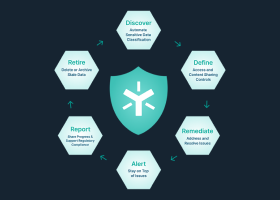
A clear overview of data governance frameworks, tools, and compliance basics.
Choosing the wrong governance tool has real consequences, including audit findings, delayed responses, and inconsistent policy enforcement across the organization. In regulated and data-intensive industries, weak governance leads to compliance exposure, operational inefficiency, and security incidents.
This is why data governance tools matter. These tools define and enforce how data is accessed, shared, retained, and audited across organizations in every industry. They create a trusted, consistent, and secure data environment, supporting better decisions, establishing compliance with regulations like GDPR and HIPAA, reducing risk (of breaches and fines), improving data quality (with better accuracy and completeness), and empowering self-service analytics for innovation. They break down silos and provide a single source of truth, essential for any data-driven operation. Together, these perks turn data into a reliable business asset for competitive advantage.
Let’s jump in and learn:
An effective governance tool is defined by execution capability rather than policy definition. Here are some capabilities that serve as a checklist to evaluate a data governance tool’s effectiveness:
These dimensions distinguish operational data governance platforms from tools that only document governance intent. Understanding what your industry requires from a governance standpoint is fundamental when comparing governance tools for your organization.
Organizations encounter several categories of governance tools, each addressing different aspects of control. Here’s a comparison overview between the major tool categories popular among industries:
For most enterprises, standalone tools increase fragmentation. Integrated data governance solutions reduce handoffs and improve consistency across environments.
A one-size-fits-all idea is irrational when it comes to data governance. Industry context is critical when selecting governance tools, as every industry has unique requirements. The following examples illustrate how data governance requirements differ by industry.
Financial institutions require strict access segregation, audit trails, and retention enforcement. Governance tools must support regulatory audits, insider risk monitoring, and controlled data sharing across internal and external parties.
Healthcare organizations manage sensitive personal and clinical data. Governance tools must enforce least-privileged access, support longer retention periods, and maintain immutable audit records for compliance and investigations.
Construction firms handle large volumes of project documents shared across partners. Governance tools must control external access, protect intellectual property, and enforce lifecycle controls without slowing collaboration.
Technology companies operate in distributed, cloud-native environments. Governance tools must support cloud data access governance, integrate with SaaS platforms, and scale with rapid data growth.
A master data governance framework defines how governance policies are translated into enforceable technical controls across systems, users, and data types. From a tooling standpoint, the framework is a set of execution requirements that governance platforms must support natively. Effective frameworks typically include:
Governance tools must support role-based ownership models that assign responsibility for data domains, access approvals, and policy enforcement. Platforms that lack granular ownership controls force organizations to manage accountability outside the system, increasing operational risk.
The tool must technically enforce sensitivity tiers such as public, internal, confidential, and regulated. Governance platforms should allow sensitivity levels to directly drive access restrictions, monitoring thresholds, and retention rules rather than existing as metadata labels only.
Governance frameworks rely on policies that map sensitivity and business context to concrete controls. Tools should enforce these rules automatically across environments, providing consistent application without customized scripting or manual intervention.
Modern frameworks require ongoing visibility into how data is accessed and used. Governance platforms must provide continuous monitoring, immutable logs, and audit-ready reporting to support regulatory reviews and internal oversight.
When evaluating data governance tools, organizations must assess whether they can operationalize the framework end-to-end across real-world systems. Data governance framework examples are only valuable when the selected tool can execute frameworks consistently, at scale, and without introducing architectural complexity or manual workarounds.
Evaluating data governance vendors requires assessing how well a platform enforces governance in production environments, not how many features it lists.
Governance fails most often at execution points, where data is accessed, shared, or retained, not at the policy-definition layer. Vendor selection should therefore prioritize architectural fit and enforcement capability over surface-level functionality. Key evaluation criteria include:
Governance platforms must enforce access, sharing, and retention policies directly where data resides, rather than relying on downstream reporting or manual controls. Tools that only document policies or flag violations after the incident introduce lag and increase risk exposure.
Modern data environments span on-prem systems, cloud repositories, SaaS platforms, and partner ecosystems. Governance vendors must provide consistent control models across those environments without requiring separate tooling or duplicated policy logic.
Effective platforms generate immutable, time-stamped records of access decisions, policy enforcement, and data movement. This evidence must be readily available for audits, investigations, and regulatory inquiries without requiring manual reconstruction or log correlation.
Governance does not operate in isolation. Platforms must integrate with collaboration tools, identity providers, and security monitoring systems so governance controls align with how users actually work and how risk is detected and managed.
The most effective data governance vendors provide platforms that embed governance into everyday data workflows, allowing organizations to maintain control at scale without slowing business operations or increasing administrative overhead.
Egnyte provides an integrated governance platform designed for organizations that operate on unstructured content. As a secure data governance platform, Egnyte:
An effective data governance program is built on data visibility and classification, enforceable access control, auditability, automation, and system integration. These pillars validate that governance policies are executed directly where data is stored, accessed, and shared, enabling consistent compliance, security, and operational efficiency across environments.
Data governance solutions enforce how data is accessed, shared, retained, and audited, while data management tools focus on storing, organizing, and processing data. Governance tools apply policy-driven controls and accountability, whereas management tools support operational use without validating compliance or risk control.
Enterprise data governance tools scale compliance by automating policy enforcement, access control, monitoring, and audit logging across hybrid and cloud environments. This reduces manual oversight, ensures consistent application of controls, and supports regulatory audits without slowing business operations or increasing administrative burden.
Data access governance tools control who can access, share, or modify data based on identity, role, and data sensitivity. They prevent unauthorized exposure, enforce least-privileged access, track usage activity, and generate audit-ready records to support security, compliance, and risk management efforts.
Egnyte improves governance frameworks by embedding enforceable access control, monitoring, and lifecycle management directly into everyday content workflows. It reduces tool fragmentation, aligns access decisions with data sensitivity, and provides audit-ready visibility, enabling organizations to operationalize governance at scale without disrupting collaboration.
Egnyte has experts ready to answer your questions. For more than a decade, Egnyte has helped more than 22,000+ customers with millions of users worldwide.

A live discussion on modern data governance, compliance challenges, and best practices.

Practical data protection tips to keep your files secure on Data Backup Day—and every day.

An overview of data governance frameworks, tools, and compliance essentials.
The General Data Protection Regulation (GDPR) and the California Privacy Rights Act (CPRA) are regional enforceable legal frameworks that dictate how organizations collect, process, retain, and disclose personal data.
GDPR compliance across the EU and UK requires organizations to lawfully process personal data, apply data minimization and purpose limitation, and uphold enforceable data subject rights throughout the entire data lifecycle. CPRA strengthens California’s privacy framework by expanding consumer rights, increasing enforcement authority, and adding stricter safeguards for sensitive personal information. These policies, although regional in nature, strongly influence global standards for building effective data compliance strategies.
Let’s jump in and learn:
Key components of an effective compliance strategy include business and technical capabilities, not just enforceable data protection policies. These key components include:
These components form the foundation of modern data security and compliance solutions that help organizations establish compliance as an ongoing operational capability rather than as reactive remediation.
Data minimization and purpose limitation are core principles under GDPR and CPRA, but they require operational enforcement to be effective. Organizations must limit data collection to defined purposes and avoid indefinite retention of personal data.
Implementing these principles requires lifecycle controls that govern when data is created, how it is used, and when it is archived or deleted. Without system-enforced controls, minimization efforts rely on manual processes that do not scale and increase compliance risk.
Managing privacy compliance across multiple jurisdictions introduces structural challenges. Some examples are:
Fragmented data environments compound these challenges. Personal data often spans file shares, cloud repositories, collaboration platforms, and legacy systems. Without centralized governance, organizations struggle to apply consistent controls or respond efficiently to regulatory requests. This fragmentation is a primary driver behind the adoption of unified data compliance solutions.
Effective GDPR and CPRA execution depends on reducing manual effort while maintaining enforceable controls. The following best practices focus on operational efficiency, consistency, and scalability across compliance workflows.
Manual data mapping is error-prone and quickly becomes outdated. Automated discovery tools allow organizations to continuously identify personal data across systems and classify it based on regulatory relevance. This capability is foundational for GDPR compliance solutions, supporting accurate inventories and faster compliance responses.
A centralized data inventory provides a single source of truth for compliance teams. It supports audits, streamlines data subject request handling, and improves oversight. Maintaining this inventory requires integration with operational systems rather than standalone documentation.
Consent and preference signals must translate into enforceable controls. Integrating consent management with processing systems helps align data usage with declared permissions. Without integration, consent records remain disconnected from actual data handling practices.
GDPR and CPRA impose strict timelines for responding to access, deletion, and correction requests. Efficient handling requires automated intake, verification, and fulfillment workflows. Organizations relying on manual coordination across teams often fail to meet statutory deadlines.
Risk-based frameworks assist organizations in allocating compliance controls based on actual exposure rather than applying uniform controls across all data. This approach is increasingly expected under GDPR and CPRA, both of which emphasize proportionality and accountability. Key elements of a risk-based privacy governance model include:
By focusing controls where risk is highest, organizations improve compliance efficiency and keep privacy investments aligned with real vulnerabilities rather than theoretical risk.
Privacy regulations are not static. GDPR guidance continues to evolve through supervisory authority decisions, while CPRA enforcement rules and interpretations are still developing. Organizations must treat regulatory monitoring as an ongoing operational requirement.
Effective approaches to regulatory adaptability include:
Data compliance solutions that support policy updates at the control level allow organizations to remain compliant without interrupting business operations or introducing governance gaps.
Privacy compliance is inherently cross-functional. Legal teams interpret regulatory requirements, IT manages systems, security enforces controls, and operations execute workflows. Without coordination, compliance efforts become fragmented and inefficient.
Key practices for effective cross-functional execution include:
When collaboration is supported by centralized governance rather than manual coordination, organizations execute compliance programs more predictably and reduce the risk of control gaps.
Future-proof privacy programs are built on scalable governance architectures rather than one-time compliance projects. Organizations must design systems that support automation, adaptability, and continuous oversight. As privacy regulations converge globally, centralized compliance platforms will become essential for maintaining control and reducing long-term risk.
Egnyte supports GDPR and CPRA programs by providing governance controls directly within enterprise content workflows. As a data governance solution, Egnyte:
Data security and compliance solutions prevent regulatory penalties by enforcing continuous data visibility, access control, audit logging, and automated compliance workflows. These controls reduce unauthorized data use, ensure timely responses to data subject access requests, and create audit-ready evidence, helping organizations to demonstrate accountability under GDPR and CPRA.
A CPRA compliance solution should offer automated data discovery, sensitive data classification, role-based access control, audit logs, consent enforcement, and efficient data subject request handling. Risk-based governance and centralized oversight are essential to apply stronger controls to high-impact data while maintaining operational efficiency.
Companies should review and update their privacy compliance strategy on an ongoing basis. CPRA enforcement rules and interpretations continue to evolve, requiring continuous regulatory monitoring, policy-to-control alignment, and system-level updates to ensure compliance remains effective without disrupting business operations.
Yes. A unified data compliance platform can support GDPR and CPRA by centralizing data discovery, access control, auditability, and automated workflows. This approach helps organizations manage overlapping obligations across jurisdictions while maintaining consistent governance and reducing the complexity of fragmented compliance tools.
Yes. CPRA increases enforcement authority and introduces stricter safeguards for sensitive personal information. Organizations that fail to implement effective data compliance solutions risk regulatory investigations, enforcement actions, and financial penalties, particularly when controls for access, deletion, and consent are inadequate.
GDPR non-compliance can result in significant financial penalties, including fines based on the severity of violations. Regulators may also impose corrective actions, audits, and restrictions on data processing. Demonstrating operational governance and audit-ready compliance controls is critical to mitigating enforcement risk.
Egnyte has experts ready to answer your questions. For more than a decade, Egnyte has helped more than 22,000+ customers with millions of users worldwide.

Understand CPRA requirements, new consumer rights, and how to prepare for compliance.
A simple guide to GDPR requirements, data protection rules, and business obligations.
IDC insights on GDPR challenges, priorities, and how leaders are responding.
See how Egnyte’s Project Hub and desktop app streamline preconstruction, accelerate project startup, and support VDC workflows.
April Lundy, Director of Technology & Business Services at Savage Brands, shares their migration success story.
Desktop Workflows, Cloud Collaboration, and Secure AI: Built for AEC. Designed for What's Next.