
Intelligent Document Classification with AI
Modern enterprises generate massive volumes of documents every day. Contracts, financial reports, engineering files, HR records, and emails accumulate quickly. Without proper organization, this information becomes difficult to find, secure, and govern.
AI document classification helps organizations solve this challenge. By automatically analyzing and organizing documents, AI transforms scattered files into structured, searchable knowledge repositories. With intelligent automation and advanced analytics, platforms like Egnyte enable enterprises to manage data efficiently while improving security, compliance, and productivity.
Let’s jump in and learn:
- Main Takeaways
- What Is Document Classification and Why Is It Important?
- What Is Intelligent Document Classification?
- Why Implement Intelligent Document Classification with AI?
- How AI Revolutionises Document Management
- The Role of Machine Learning in Intelligent Document Classification
- Tailoring Your Document Management Strategy Effectively
- Streamlining Documentation Processes for Optimal Results
- How to Improve Your Business Operations with Advanced Document Classification
- Conclusion
Main Takeaways
- AI document classification automates the sorting and tagging of enterprise files, reducing manual workload.
- Intelligent document classification improves search, governance, and collaboration across distributed teams.
- Sensitive data classification identifies confidential information and applies protection policies automatically.
- Document categorization enhances operational efficiency by ensuring documents are stored in the correct location.
- Egnyte’s AI-powered AI content intelligence enables organizations to extract insights from large volumes of unstructured data.
- Automatic document classification reduces errors, improves compliance, and speeds up business processes
What Is Document Classification and Why Is It Important?
Document classification is the process of organizing files into predefined categories based on their content, type, or sensitivity.
In modern organizations, most data exists as unstructured content, including PDFs, spreadsheets, scanned documents, and emails. Without proper classification, this information becomes difficult to manage.
Key benefits of document classification include:
- Faster document retrieval
- Employees spend less time searching for files.
- Teams access the right information instantly.
- Improved compliance
- Classification helps organizations with sensitive data classification.
- It supports security policies and audit readiness.
- Better governance
- Businesses can enforce retention rules and access permissions.
- Structured classification enables consistent data classification policies.
- Lower operational costs
- Organized files reduce redundant storage.
- Automated archiving improves lifecycle management.
For enterprises managing thousands or millions of files, effective classification is the foundation of efficient digital document management.
What Is Intelligent Document Classification?
Intelligent document classification uses artificial intelligence and machine learning to automatically analyze documents and assign appropriate labels.
Unlike traditional rule-based systems, AI document classification understands context, patterns, and relationships within documents.
Modern systems can:
- Analyze text, metadata, and document structure
- Extract key entities such as names, dates, and financial values
- Recognize document types across multiple formats
- Learn continuously from user feedback
For example, a legal firm processing contracts can rely on automatic document classification to identify clauses and categorize files instantly without manual sorting.
Key capabilities include:
- Processing thousands of documents per minute
- Recognizing industry-specific terminology
- Supporting multiple document formats including scans and images
- Integrating with enterprise workflows
Platforms like Egnyte use advanced AI content intelligence to power intelligent document classification across enterprise content environments.
Why Implement Intelligent Document Classification with AI?
Manual classification cannot keep up with modern data growth. Organizations today generate terabytes of documents across departments and cloud systems daily.
Implementing AI document classification delivers measurable business benefits:
- Scalability
- AI handles growing document volumes without increasing staff.
- Improved compliance
- Automated sensitive data classification identifies regulated data like PII or financial records.
- Reduced operational risk
- AI detects misfiled or unprotected documents during confidential data classification.
- Better collaboration
- Teams find relevant documents faster thanks to better document categorization.
- Operational insights
- Document analytics reveal trends and process bottlenecks.
For executives and IT leaders, document classification transforms document management into a strategic capability rather than a manual administrative task.
How AI Revolutionises Document Management
Artificial intelligence changes document management from reactive storage into proactive intelligence.
By automating document categorization, AI document classification turns enterprise data into a searchable, structured knowledge base.
Boosting Efficiency with Automated Sorting
Automatic document classification eliminates manual sorting tasks.
Instead of employees organizing files individually, AI document classification automatically routes files to the correct location.
Examples of efficiency improvements include:
- Accounts payable automation
- AI categorizes invoices by vendor and date.
- Approval workflows start automatically.
- HR document processing
- Employee forms and contracts are classified instantly.
- Sensitive data classification ensures confidential files receive restricted access permissions.
- Engineering documentation
- Design files are organized by project, version, and type.
Key benefits:
- Faster document intake processes
- Reduced manual errors
- Automated workflow triggers
- Integration with enterprise systems like ERP or CRM
Achieving Accuracy with Precise Categorization
AI document classification delivers higher accuracy than manual processes.
Human classification often produces inconsistent results. AI models analyze context across entire documents to improve accuracy.
Benefits of precise document categorization include:
- Lower misclassification rates
- Improved document retrieval
- Stronger compliance through confidential data classification
- Better collaboration across teams
For example, a financial services firm can classify loan applications by risk category automatically. Teams focus on reviewing exceptions rather than sorting routine documents.
Continuous model training ensures classification accuracy improves over time.
The Role of Machine Learning in Intelligent Document Classification
Machine learning is the engine behind AI document classification.
ML algorithms learn from labeled datasets and recognize patterns within documents. Models improve over time, enabling more accurate intelligent document classification and sensitive data classification.
Key machine learning approaches include:
- Supervised learning
- Models learn from pre-labeled document examples.
- Unsupervised learning
- Algorithms identify patterns and discover new document types.
- Reinforcement learning
- The system improves classification accuracy based on user feedback.
Consider this example. A pharmaceutical company may classify clinical trial documents automatically. The system identifies proprietary research sections and applies confidential data classification policies. Such automation helps enforce governance policies and supports automated data governance initiatives across large organizations.
Tailoring Your Document Management Strategy Effectively
Organizations must align AI document classification with their workflows.
Steps to tailor classification strategies include:
- Define core document categories such as:
- Public
- Internal
- Confidential
- Restricted
- Align classifications with compliance requirements.
- Implement retention and archiving policies.
- Monitor classification performance through analytics dashboards.
Egnyte enables organizations to build customized AI document classification models across industries.
We can understand this better with an example. A bank implemented AI document classification for compliance records. Automated tagging reduced regulatory review time by more than 60%.
Streamlining Documentation Processes for Optimal Results
AI document classification improves workflows across departments.
By integrating AI-powered document categorization with enterprise systems, businesses create efficient and secure document ecosystems.
Key improvements include:
- Unified data visibility
- AI connects documents across cloud storage, endpoints, and on-prem systems.
- Secure collaboration
- Access permissions ensure easy collaboration using sensitive data classification.
- Advanced search
- AI enables semantic search across large repositories.
- Version control
- Systems automatically manage document updates and duplicates.
These capabilities strengthen enterprise digital document management strategies while improving employee productivity.
How to Improve Your Business Operations with Advanced Document Classification
Organizations can implement advanced AI document classification through a structured approach.
Recommended steps include:
- Conduct a document audit
- Identify key repositories and high-volume file types.
- Define classification policies
- Establish rules for document types and security levels.
- Deploy intelligent classification tools
- Implement AI-powered solutions such as Egnyte.
- Train models using sample datasets
- Provide labeled examples for higher AI document classification accuracy.
- Measure performance metrics
- Monitor classification accuracy and processing speed.
- Scale across departments
- Expand automation across the enterprise.
Many organizations report measurable benefits, including:
- Productivity improvements of up to 40%
- Faster document retrieval
- Stronger data governance
- Reduced compliance risks
Conclusion
Organizations today face growing challenges in managing vast amounts of unstructured data. Without proper organization, critical documents remain hidden, compliance risks increase, and productivity declines.
AI document classification solves this challenge by automating how documents are analyzed, categorized, and protected. With intelligent document classification, businesses gain faster search capabilities, stronger governance, and improved operational efficiency.
Platforms like Egnyte enable enterprises to implement automatic document classification, document categorization, and sensitive data classification at scale. The result is a smarter, more secure AI document classification environment that supports modern digital operations.
Frequently Asked Questions
Smarter document management improves performance by organizing data for quick, secure access. AI automates storage and retrieval, reducing search time and manual effort. This helps teams work faster, collaborate better, and make quicker decisions.
Precise classification ensures documents are easy to find and correctly stored. It reduces errors and manual work while enabling automated workflows. This leads to faster processes and improved operational efficiency.
Start by auditing your documents and defining classification categories. Deploy an AI solution, train it with sample data, and test accuracy. Once validated, roll it out across the organization and monitor performance for continuous improvement.
Document categorization organizes files into clear structures, making them easier to access and manage. It supports automated workflows and consistent processes, reducing delays and improving operational flow.
Yes, AI boosts productivity by automating tasks like sorting, tagging, and retrieval. It reduces manual effort and errors, allowing employees to focus on higher-value work and make faster decisions.
AI analyzes document content, metadata, and structure using machine learning and NLP. It then assigns categories and applies rules in real time, ensuring consistent organization without manual input.
AI improves speed, accuracy, and scalability in document handling. It reduces errors, strengthens compliance, and enables better insights from enterprise data.
AI improves search by understanding context, not just keywords. This helps users find relevant documents faster, even in large datasets, improving overall content discovery.
AI identifies and tags sensitive data automatically, such as personal or financial information. It enforces security policies and access controls, reducing compliance risks and simplifying audits.
Egnyte has experts ready to answer your questions. For more than a decade, Egnyte has helped more than 23,000+ customers with millions of users worldwide.
Additional Resources

What Is Data Classification and Why It Matters
Sort and categorize information assets to improve security, compliance, and faster data retrieval.
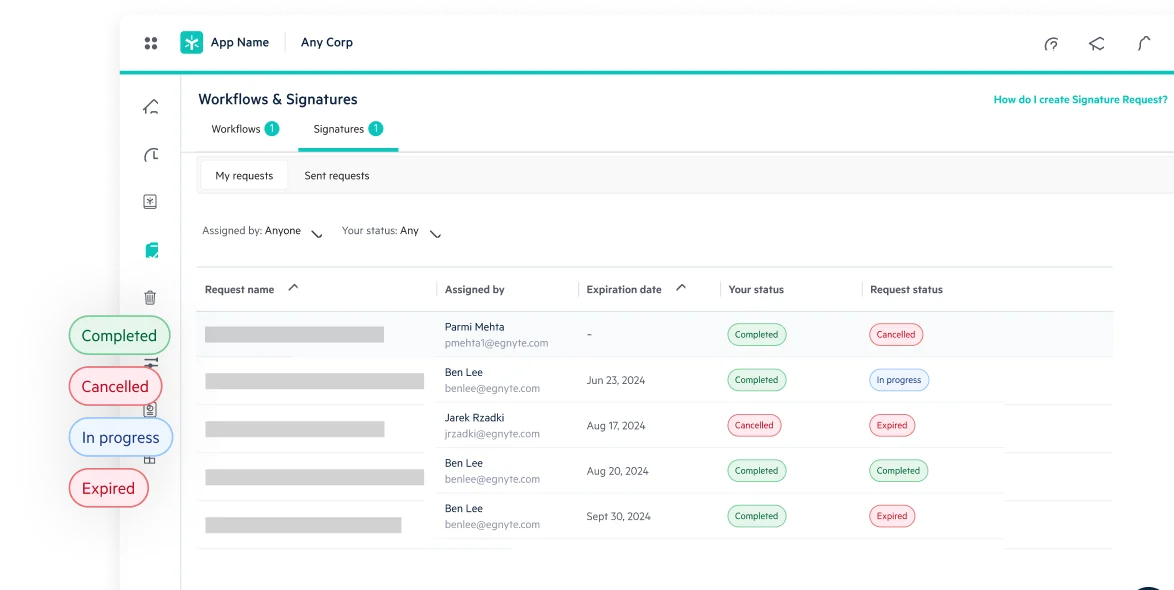
Automate Document Workflows with AI-Powered Tools
Extract metadata, classify files, trigger approvals, and connect with existing tools without manual effort.
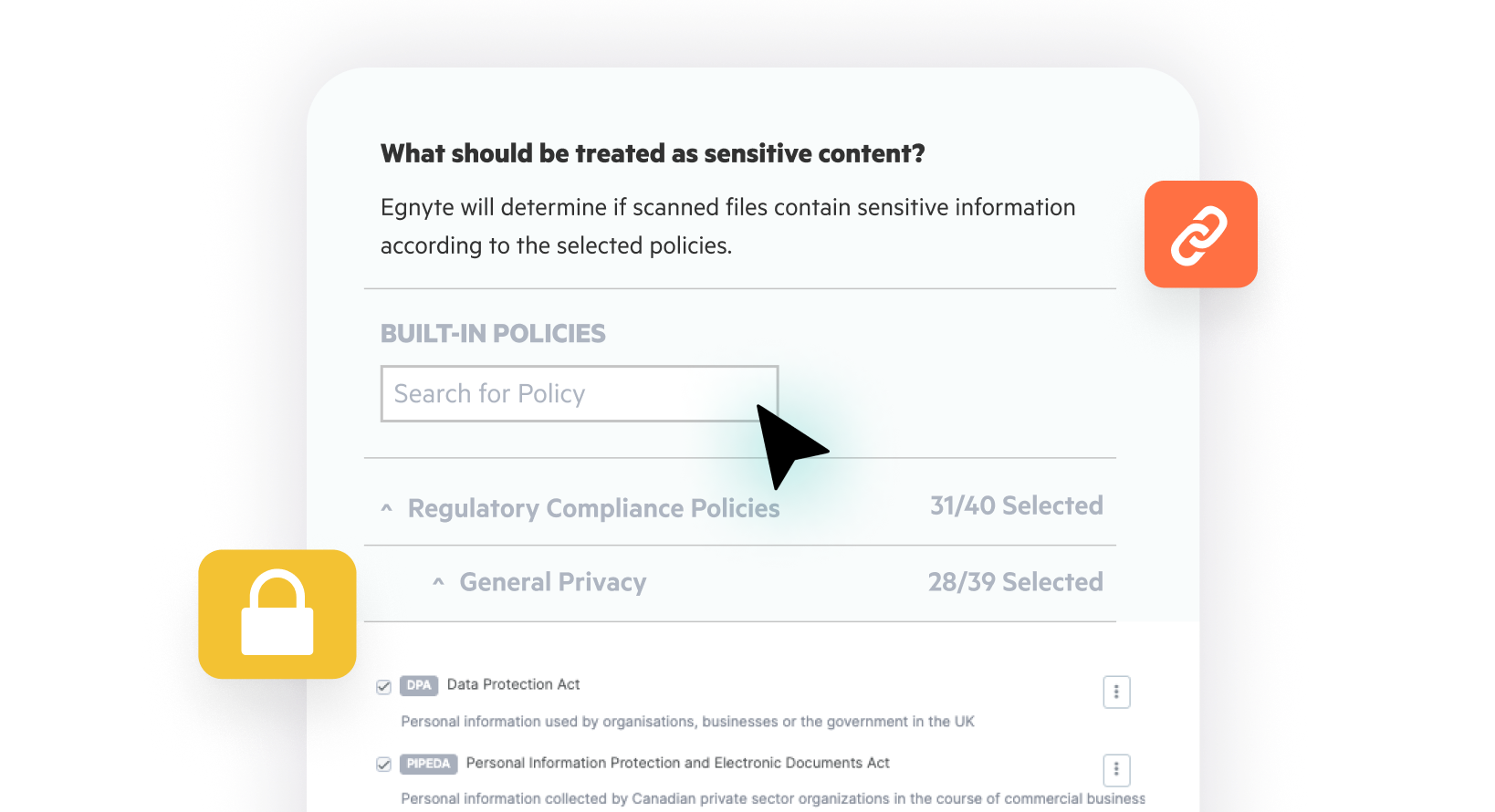
Protect Sensitive Content with AI-Powered Classification
Identify, classify, and secure sensitive data across all repositories to reduce exposure and meet compliance requirements.