
Automated Data Governance: Improving Efficiency & Compliance
Fragmented repositories, manual policy checks, and ad‑hoc permission settings have transformed data oversight into a costly burden. With data volume skyrocketing and regulations tightening, relying on traditional, spreadsheet-based methods is no longer sustainable or efficient.
This is where Automated Data Governance comes in. By embedding policy enforcement, classification rules, and lifecycle controls into an automated data governance platform, enterprises move beyond periodic audits to real-time safeguards. Governance logic operates the moment data is created or moved: whether on local servers, cloud apps, or enterprise file sharing workspaces. This leads to continuous protection and faster, insight-ready data flows.
In this blog, we outline the benefits, explore the key features of automated data governance solutions, and explain how automation enhances compliance and efficiency.
Let’s jump in and learn:
Key Takeaways:
- Automated Data Governance replaces manual, spreadsheet-based processes with real-time policy enforcement and continuous monitoring, reducing errors and operational overhead.
- Automation strengthens compliance through consistent rule application, immutable audit trails, and instant detection of violations or unusual activity.
- Clean, well-classified data accelerates decision-making and enables advanced analytics and AI by ensuring teams have fast access to trusted information.
- Egnyte delivers a unified governance platform with automated classification, lifecycle controls, granular permissions, and built-in threat protection for secure, scalable oversight across cloud and hybrid environments.
Benefits of Automated Data Governance
Rising data volume and stricter regulations have exposed the limits of manual controls. As a result, enterprises are largely pushing toward Automated Data Governance powered by an intelligent platform. By extending those safeguards into cloud data governance environments, businesses gain real-time oversight while laying the groundwork for advanced analytics and AI.
Continuous Compliance Monitoring
An automated data governance platform embeds policy engines and machine-learning checks and balances that inspect every file move or schema change against applicable regulations, in real-time. Instead of quarterly audits, organizations get always-on oversight that flags violations instantly and can launch automated remediation activities, commonly referred to as auto-remediation.
Boosted Efficiency and Reduced Costs
By automating retention, classification, and remediation tasks, teams can ditch spreadsheet-driven workflows and manual access reviews. This frees IT and data stewards to focus on optimization initiatives while trimming storage and labor expenses: one of the core benefits of automated data governance.
Accelerated Decision-Making Processes
Clean, well-labeled data flows progress straight into dashboards without staging delays. Analysts gain near-instant access to trustworthy datasets, allowing finance, sales, and operations leaders to adjust strategies on the fly.
Strengthened Data Security Measures
Automated classification tags sensitive content at creation and applies encryption, masking, or quarantines (depending on the baseline technology). without user intervention. Continuous scans also surface anomalous access patterns, blocking unauthorized sharing before security incidents occur.
Enabling Advanced Analytics and AI Capabilities
Data quality rules, lineage graphs, and usage telemetry are automatically injected into pipelines. Data science teams can train models more quickly and with greater confidence because the underlying data is already governed.
Gaining Competitive Advantage
Robust automation accelerates compliance sign-offs, raises data trust, and lowers operating costs. The best automated data governance tools turn information from a liability into an asset, giving organizations quicker product launches and stronger customer experiences than competitors that still rely on manual controls.
Key Features of Automated Data Governance Solutions
Leading automated data governance platforms combine machine intelligence with policy engines to govern information the moment it enters a cloud file server or virtual data room. The table below outlines four core capabilities that set the best automated data governance tools apart.
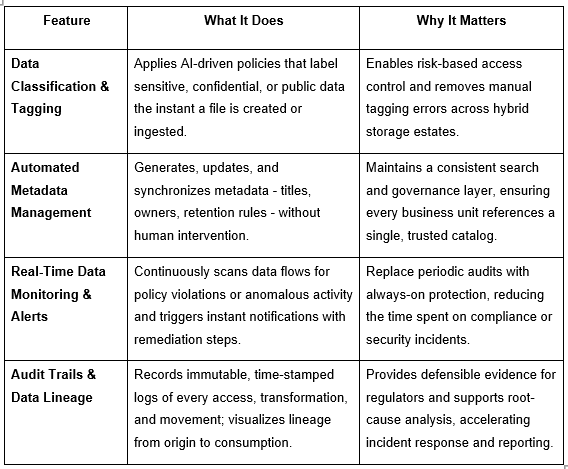
Together, these capabilities allow organizations to enforce policy at machine speed, maintain transparent oversight, and unlock analytics-ready data without sacrificing compliance or security.
How Automated Data Governance Improves Compliance
and regulatory pressure, compliance becomes a continuous process: embedded into every file, folder, and workflow. This shift strengthens oversight while reducing manual intervention and audit fatigue.
Policy Enforcement Without Gaps
Automated governance ensures that retention, access, and classification policies are uniformly applied across all storage layers - from structured repositories to unstructured content. This prevents silo-based rule fragmentation and enforces consistency, even as data moves across systems.
Always-On Monitoring
Instead of relying on monthly or quarterly reviews, governance platforms offer real-time data activity monitoring. This allows immediate detection of non-compliant behavior, like policy violations, unapproved access, or suspicious log-ins, before risk escalates.
Comprehensive Audit Trails
Every action taken is automatically logged with timestamps and user details. These detailed audit trails not only support internal investigations but also simplify compliance reporting for external audits.
AI-Driven Classification
Using pre-trained models and natural language processing, platforms automatically classify sensitive data the moment it’s created or uploaded. This minimizes dependency on user discretion and increases the reliability of compliance controls.
Instant Risk Identification
Dashboards surface anomalies like bulk downloads, unusual access attempts, or data residing outside of compliant locations. Teams can trigger automatic responses, such as access revocation or file quarantine, before breaches occur.
Agility with Regulation Updates
As regulations like GDPR, HIPAA, or CPRA evolve, rule sets can be centrally updated across the platform. These changes are instantly reflected across governed content, without requiring time-consuming manual reclassification or remediation.
Fewer Human Errors
By removing manual processes for tagging, auditing, or approval routing, the likelihood of oversight or inconsistent enforcement drops drastically. This reinforces data integrity and trustworthiness, especially in regulated environments.
Simplified Audit Preparation
With automated logs and pre-configured reports, audit preparation becomes a click-driven task. For organizations using a secure content collaboration solution, these reports align directly with team workflows, eliminating the need to switch platforms or duplicate documentation.
Egnyte’s Automated Data Governance Platform
Egnyte offers a unified, hybrid-ready solution designed to simplify and secure enterprise data governance across cloud andon-prem deployments. Here’s what it delivers:
- Centralized Content Oversight: Consolidates files from servers, cloud drives, , and third-party data stores into one secure platform.
AI-Driven Data Classification: Automatically identifies and tags sensitive content using metadata and machine learning.
Policy-Based Lifecycle Management: Automates data retention, archival, and deletion workflows to reduce risk and control storage costs.
Granular Access Control & Audit Trails: Applies role-based permissions and immutable logging for full visibility and regulatory alignment.
Seamless Productivity Tool Integrations: Works with Microsoft 365, Google Workspace, and other commonly-deployed data platforms, without compromising data governance.
- Built-In Threat Protection: Detects potential ransomware, enables quick recovery through snapshots, and identifies compromised files automatically.
Case Studies and Success Stories
Here are two case studies that demonstrate Egnyte’s automated data governance platform in action across complex, regulated environments:

Challenge
A multi-office environmental consultancy struggled with fragmented field data stored in analog systems and onsite servers. Geographically dispersed teams often delayed critical document transfers, disrupting modeling workflows and jeopardizing project timelines and data consistency.
Solution
Egnyte was deployed as a centralized enterprise file sharing system, acting as a unified repository for all project data. It enabled secure, real-time syncing between remote field teams and central offices. AI-powered file versioning ensured the latest CAD and environmental impact reports were always accessible, regardless of location or connectivity.
Outcomes
- Field and office teams co-edit documents in real-time with no version mismatches.
- Self-service data recovery improved resilience across 21 offices.
- Engineers regained productive time previously lost to administrative delays - hundreds of hours annually - enhancing client response and project integrity.
Read the full story here.

Challenge
A provider of interactive response technology (IRT) for clinical trials faced strict regulatory demands: audit trail data had to be accurate, independent, and securely shared with investigators, without sponsor interference.
Solution
Egnyte powered a compliance-centric portal that allowed precise audit-log sharing with investigators. Granular permissions, immutable audit trails, and role-based access secured compliance while maintaining sponsor oversight. Egnyte’s platform acted as an intermediary solution that met both transparency and regulatory requirements.
Outcomes
- Achieved 100% GxP audit compliance with demonstrable lineage and data integrity.
- Enabled granular permission levels - one stakeholder could have edit rights, another could view-only - while preserving audit trail fidelity.
- Improved client confidence and expanded pipeline opportunities with prospective sponsors and research sites.
Read the full story here.
Conclusion
For enterprises navigating today’s data landscape, manual governance simply can’t keep pace with the speed, scale, and regulatory demands of digital operations. From maintaining compliance and securing sensitive content to unlocking the full potential of analytics and AI, the benefits of automated data governance are strategic and measurable.
Yet achieving this requires a platform that does more than monitor. It must automate classification, enforce real-time policies, provide end-to-end auditability, and adapt as the business - and its risks - evolve.
Egnyte’s automated data governance platform delivers on this promise.
Designed for hybrid and cloud-native environments, it brings together secure enterprise file sharing, intelligent policy enforcement, and seamless lifecycle management: All within a single, scalable solution.
For organizations aiming to reduce risk, increase agility, and drive value from their data, Egnyte offers a reliable foundation for enterprise-grade, future-ready governance.
Frequently Asked Questions:
1. Why are organizations increasingly turning to automation for data governance?
The exponential growth of enterprise data has made manual oversight unsustainable. Organizations are turning to automated data governance platforms to eliminate fragmented controls, reduce administrative burden, and maintain continuous compliance. By embedding governance directly into data pipelines, these platforms enable real-time policy enforcement, faster audits, and secure enterprise file sharing. The benefits of automated data governance include improved efficiency, reduced cost, and greater agility in responding to evolving regulatory demands.
2. How does automation improve the accuracy and reliability of compliance processes?
Automated governance removes the variability and delays inherent in human-led compliance workflows. With features like automated data classification, rule-based access control, and real-time monitoring, automation ensures consistent enforcement of policies across all content sources. It also generates immutable audit trails, which simplify reporting and increase transparency. This leads to more accurate, timely, and traceable compliance processes.
3. What role does AI play in modern automated data governance platforms?
Artificial intelligence is central to the scalability and intelligence of automated data governance. AI-driven classification engines detect and tag sensitive data such as PII or PHI, even within unstructured formats. Machine learning models also detect anomalies, predict risk exposure, and refine governance policies based on usage patterns. These capabilities power cloud data governance at scale, enabling organizations to extract actionable insights while maintaining robust control over sensitive information.
4. What steps can organizations take to ensure that automated data governance aligns with their overall cybersecurity strategy?
To ensure alignment, organizations should select a secure cloud storage solution with built-in data governance features, such as end-to-end encryption, Role-Based Access Control (RBAC), and ransomware detection. Automated governance workflows should be integrated with existing SIEM, DLP, and identity management tools to maintain cohesive control. Finally, adopting a platform like Egnyte, which combines a data governance solution with cybersecurity best practices, ensures that governance is not an add-on but a foundational layer of the broader security posture.
Egnyte has experts ready to answer your questions. For more than a decade, Egnyte has helped more than 23,000+ customers with millions of users worldwide.
Additional Resources

Secure & Scalable Collaboration for Enterprise Teams
Enable seamless, real-time file sharing and collaboration across your organization — with built-in security, access controls, and ...
Unleash Data Value with Content-Aware Protection
Download Egnyte’s IDC Spotlight to learn how AI-powered, context-aware security protects your data against ransomware, ...
Kickstart Secure Governance with Egnyte
A beginner-friendly guide to set up file security, access controls, and governance workflows on Egnyte — ideal ...