
What is contract review automation and Its Impact on Business Operations
Contract review is one of the most resource-intensive responsibilities within legal and operational teams. Manual workflows, inconsistent review standards, and fragmented communication channels often slow the pace of business and increase the likelihood of errors or overlooked obligations. These issues become more challenging as organizations grow and contract volumes expand across departments.
Legal teams are expected to protect the organization from risk while enabling the business to move quickly. Yet traditional review processes rarely support that balance. They demand repetitive, time-consuming work and create bottlenecks that make it difficult to maintain consistency, enforce compliance expectations, or provide timely guidance to stakeholders.
Recognizing these pressures, many organizations are re-evaluating how contract reviews should be executed. Instead of relying on manual effort, they are shifting toward solutions that bring structure, predictability, and greater control to the review cycle. This transition has positioned Contract Review Automation (CRA) as a strategic capability for modern legal and enterprise operations.
CRA standardizes review steps, enhances accuracy, and gives legal teams the visibility required to manage obligations with confidence. It supports faster turnaround times, reduces operational strain, and strengthens the organization’s ability to scale contract processes without compromising governance or legal oversight.
Let’s jump in and learn:
- Main Takeaways
- How Does Contract Review Automation Work?
- The Significance of Contract Review Automation in Business Operations
- Key Steps to Implementing Contract Automation
- Who Can Benefit From Contract Review Automation?
- The Future Trajectory of Contract Review Automation
- How Egnyte leverages as a Robust Contract Review Automation Tool for Operational Efficiency
Main Takeaways
- Contract review automation accelerates business execution by removing manual bottlenecks and shortening approval cycles across legal, finance, and procurement teams.
- Risk and compliance outcomes improve immediately when automation enforces standardized clauses, consistent terminology, and policy-aligned reviews.
- A structured rollout delivers measurable ROI, especially when organizations start with high-volume contracts, map required controls, and automate repeatable review steps.
- Ongoing monitoring is essential, ensuring automation rules evolve with new regulations, updated risk frameworks, and changing business requirements.
- Automation gives leadership operational clarity, offering real-time visibility into contract status, compliance posture, and cycle-time metrics for better decision-making.
How Does Contract Review Automation Work?
Contract review automation operates through a suite of advanced technologies designed to replicate and enhance human review capabilities. Here are the key technologies powering this transformation:
Artificial Intelligence and Machine Learning
AI models trained on thousands of contracts recognize patterns, clause types, and risks. They learn from each review, continuously improving accuracy and adapting to your organization's unique standards.
Natural Language Processing (NLP)
Contracts are written in complex legal language that can be difficult to parse quickly. NLP enables machines to ‘understand’ and interpret text, identify meaning and context, and extract relevant clauses with precision. Critically, it distinguishes between superficially similar clauses with different legal implications, something that basic keyword searches miss entirely.
Rule-Based Analysis
Organizations can pre-define acceptable standards using a contract review checklist, such as approved indemnity clauses, payment timelines, or liability caps. The system automatically flags any deviations from these playbook standards, ensuring consistency across all agreements while allowing strategic flexibility where it matters most.
Risk Identification and Scoring
Automated contract review software highlights potential legal, financial, and operational risks, then assigns priority scores based on business impact. This risk stratification allows leadership teams to focus their expertise on high-stakes negotiations rather than routine compliance checks.
Workflow Automation
Once analyzed, contracts are routed automatically for approvals, revisions, or execution based on their risk profile and stakeholder requirements. This eliminates manual follow-ups and email chains, creating an auditable path from review to signature that scales effortlessly with contract volume.
The Significance of Contract Review Automation in Business Operations
The significance of CRA becoming a strategic investment for organizations worldwide is multi-dimensional :
Organizational Intelligence Accumulation – Every contract reviewed by AI becomes training data for institutional memory. Unlike human reviewers who leave when they quit, automated systems capture negotiation patterns, successful clause variations, and counterparty behaviors, building a knowledge asset that appreciates over time.
The Negotiation Leverage Gap – Manual review processes lack bandwidth to analyze historical concessions, benchmark terms across similar agreements, or identify competitor patterns. Automation closes this intelligence gap, transforming contracts from legal documents into competitive weapons that reveal what terms are truly negotiable.
Scaling Without Diluting Quality – Traditional approaches force an impossible trade-off: slow down growth to maintain review quality, or accelerate deals at the expense of risk exposure. Contract review automation eliminates this false choice, allowing organizations to simultaneously increase contract velocity and strengthen review rigor.
The Compliance Paradox Resolution – Regulatory requirements intensify yearly, yet legal teams shrink relative to business growth. Automated review transforms compliance from a constraint into a continuous background process, monitoring regulatory changes, flagging non-conforming language, and updating playbooks automatically without creating bottlenecks.
Key Steps to Implementing Contract Automation
Step | Description |
1. Define Your Objectives | Clearly establish why you're implementing automation. Like, whether to accelerate reviews, improve compliance, reduce legal workload, or enable growth. Set specific, measurable goals and document success metrics that align with business priorities. |
2. Choose the Right Platform | Assess platforms based on accuracy, scalability, security, customization capabilities, and integration with existing systems. Run pilot projects with real contracts to test performance before making a commitment. |
3. Train the System | Feed the system your actual contracts, approved templates, organizational standards, and examples of both acceptable and problematic clauses. Set up risk thresholds, approval workflows, and your contract review checklist within the platform. |
4. Validate the Results | Run parallel reviews where human experts verify the same contracts the AI processes, then compare results and fine-tune rules based on feedback. Document validation outcomes to build stakeholder confidence and ensure alignment with organizational risk tolerance. |
5. Integrate with Your Ecosystem | Integrate the platform with your CLM, ERP, CRM, document management, and e-signature systems to create seamless data flow across departments. This transforms automation from a standalone tool into a core operational capability that enables end-to-end contract processing. |
6. Monitor and Continuously Improve | Track key metrics like accuracy rates, review times, risk flags, and user adoption while gathering feedback from stakeholders. Update rules as regulations change and retrain AI models with new contract data to maximize long-term value. |
Who Can Benefit From Contract Review Automation?
Contract Review Automation delivers value across many roles and functions:
- Legal and Compliance Teams : Contract Review Automation software reduces manual workload, consistent application of standards, and enhances risk visibility for the legal team.
- Sales Organizations : Faster contract approvals directly impact sales velocity, allowing revenue teams to close deals quicker thereby improving forecast accuracy.
- Procurement and Vendor Management : Automation accelerates supplier onboarding, enforces contract compliance alongside providing visibility into possible supplier risks and performance.
- Operations and Project Management : By ensuring contracts are reviewed accurately and quickly, operations teams can avoid delays that impact timelines and deliverables.
- Human Resources: Streamline employment contracts, offer letters, and policy documents at scale.
The Future Trajectory of Contract Review Automation
The future of contract review automation lies in deeper intelligence and predictive capabilities.
- AI will shift from clause detection to contextual legal reasoning, enabling deeper interpretation of obligations, intent, and negotiation positions.
- Predictive risk analytics will guide decisions earlier, helping teams anticipate risks and shape contract strategy before drafting begins.
- Contract drafting will become semi-automated, with systems generating first-draft agreements aligned to company playbooks and risk thresholds.
- CRA will integrate seamlessly across enterprise systems, connecting with CRM, ERP, procurement, and governance platforms to unify contract data.
- Governance and security automation will become foundational, ensuring every contract complies with regulatory, privacy, and internal control requirements without manual oversight.
How Egnyte leverages as a Robust Contract Review Automation Tool for Operational Efficiency
Egnyte supports this shift by combining secure collaboration, automated document processing, governance controls, and advanced content intelligence solutions in a single platform.
Egnyte streamlines contract review by classifying content automatically, identifying risks earlier, and providing audit-ready documentation without manual effort. Its AI-driven capabilities help teams manage large volumes of contractual data with clarity and control.
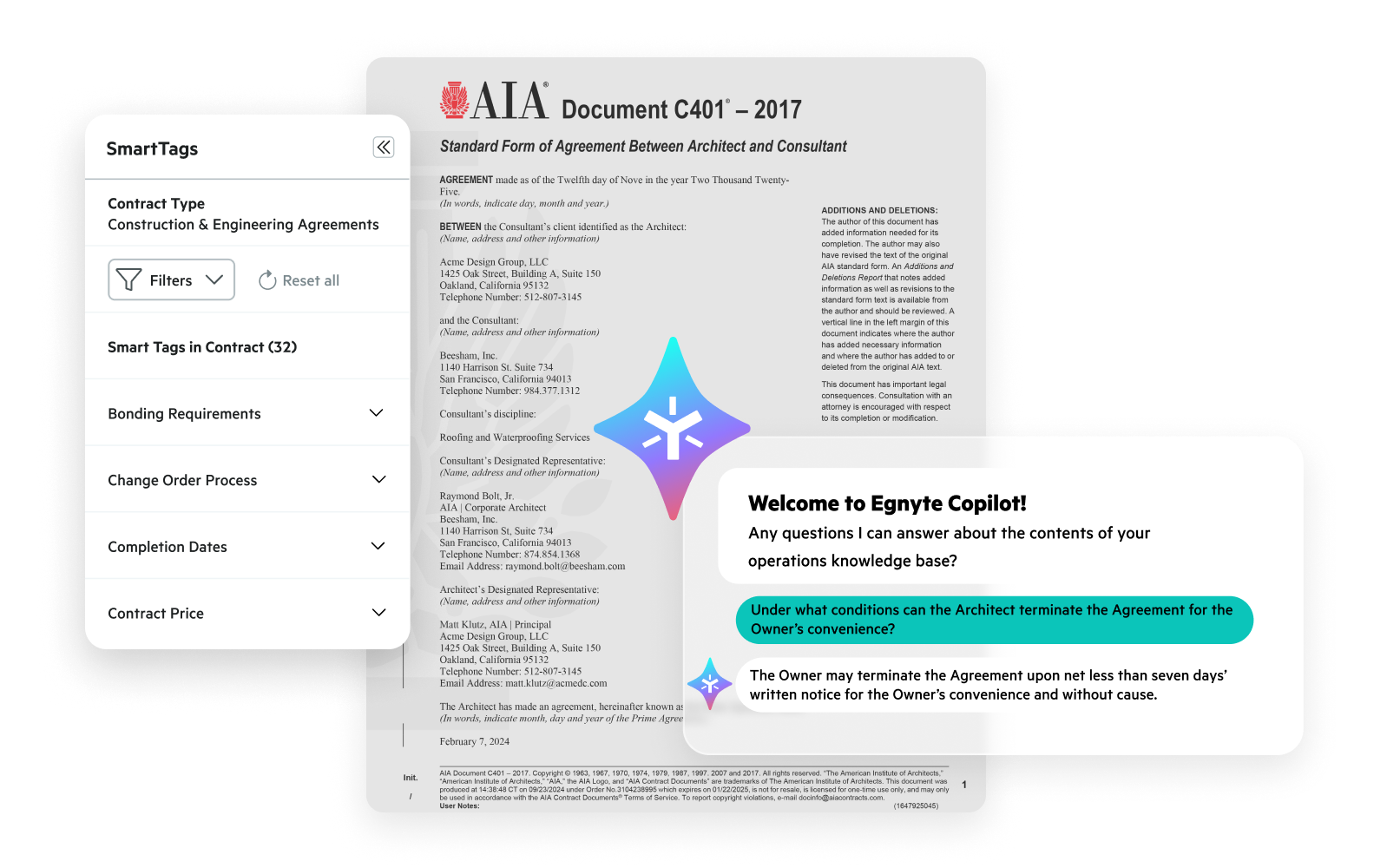
With Egnyte’s AI Assistant, legal and business teams can summarize documents, ask natural-language questions, and generate content securely within the data intelligence cloud. This allows organizations to accelerate review cycles, reduce operational burden, and make informed decisions with greater confidence.
Frequently Asked Questions
Contract review automation uses AI, natural language processing, and rule-based logic to analyze contracts automatically. It identifies clauses, flags risks, checks compliance against predefined standards, and routes agreements through workflows, reducing manual review effort while maintaining legal and operational oversight.
It removes manual bottlenecks by standardizing review steps and accelerating approvals. Contracts move faster across legal, finance, and procurement teams, with fewer errors and clearer accountability. This improves cycle times, consistency, and visibility into contract status across the organization.
Yes. Automation enforces standardized clauses, approved terminology, and policy-aligned reviews. It flags non-compliant language, tracks regulatory obligations, and maintains audit trails, helping organizations reduce compliance risk while keeping reviews consistent as regulations and standards evolve.
Industries with high contract volumes benefit most, including legal services, financial services, healthcare, manufacturing, technology, procurement-driven enterprises, and HR departments. Any sector managing repetitive agreements or regulatory exposure can gain efficiency, accuracy, and stronger governance.
Automation reduces time spent on repetitive reviews, manual comparisons, and follow-ups. Legal and business teams focus on high-risk or strategic negotiations instead of routine checks, allowing more work to be completed with the same resources and improving overall operational throughput.
Contracts should be reviewed at creation, during amendments, before renewals, and when regulations or business policies change. Automated systems can also run continuous reviews, ensuring obligations, deadlines, and compliance requirements remain visible throughout the contract lifecycle.
Yes. Modern tools support a wide range of contracts, including sales agreements, supplier contracts, NDAs, employment agreements, leases, and compliance documents. AI models adapt to varied formats and language, enabling consistent review across diverse contract portfolios.
Egnyte has experts ready to answer your questions. For more than a decade, Egnyte has helped more than 22,000+ customers with millions of users worldwide.
Additional Resources

AI Contract Analyst
Instant clause and obligation insights with Egnyte’s AI Contract Analyst.
Making Contracts Simple for Your Team
Turn dense legal language into simple, actionable insights with Egnyte AI.

Benefits of Contract Workflow Automation
Streamline contract workflows with automation that boosts efficiency and cuts manual work.