
Secure External Collaboration Without Losing Control of Enterprise Data
Organizations today rely on a growing network of vendors, consultants, contractors, clients, and strategic partners. While these relationships drive innovation and business growth, they also create new challenges around data protection, compliance, and governance.
The need for secure external collaboration has never been greater. Business leaders must enable teams to share information quickly while maintaining visibility, control, and security over critical enterprise content. The right approach allows organizations to collaborate efficiently without increasing risk, creating a balance between productivity and protection.
Let’s jump in and learn:
- Main Takeaways
- The Importance of Secure Enterprise Collaboration
- What Is Secure Data Control in Enterprise Collaboration?
- Steps to Ensuring Secure External Collaboration
- Secure File Sharing Options for Modern Enterprises
- The Role of Advanced Technology in Ensuring Data Security During Collaboration
- Integrating User Training and Awareness in Secure Collaboration
- Harnessing a Robust Framework for Effective Control of Your Data
- Conclusion
Main Takeaways
- Secure external collaboration helps organizations work seamlessly with external stakeholders while maintaining control over sensitive business data.
- Strong governance, visibility, and access controls are the foundation of secure enterprise collaboration.
- Modern external collaboration tools provide secure access, real-time monitoring, and policy enforcement across distributed teams.
- Secure file sharing options reduce the risks associated with email attachments, unsecured links, and shadow IT.
- AI-powered analytics and automation help organizations identify threats before they become security incidents.
- User training remains essential for minimizing human error and strengthening security practices.
- Egnyte's Content Cloud combines collaboration, governance, compliance, and security within a single platform.
The Importance of Secure Enterprise Collaboration
Business success increasingly depends on collaboration beyond organizational boundaries. Whether coordinating with suppliers, sharing project documents with consultants, or providing clients with access to files, organizations must ensure information remains protected throughout every interaction.
Secure enterprise collaboration enables organizations to:
- Share information confidently with external stakeholders
- Maintain compliance with industry regulations and security requirements
- Reduce operational bottlenecks caused by inefficient file-sharing methods
- Protect intellectual property and sensitive business information
- Support hybrid and distributed work environments
- Improve project delivery timelines and stakeholder communication
Consider an architecture firm working with engineers, contractors, and project owners across multiple locations. Without proper controls, project documents can quickly become fragmented, outdated, or exposed to unauthorized users. A centralized collaboration platform eliminates these challenges while maintaining governance.
What Is Secure Data Control in Enterprise Collaboration?
At its core, secure data control refers to an organization's ability to determine who can access, view, edit, share, and download content throughout the collaboration lifecycle.
Many organizations ask, what is external collaboration in a modern business environment? Simply put, it is the process of securely sharing information and working with individuals outside the organization while maintaining governance over enterprise data.
Effective data control ensures that collaboration remains productive without sacrificing security.
Essential Aspects of Data Control in Business Collaborations
Strong data governance typically includes:
- Granular permissions that define user access levels
- Role-based controls for internal and external stakeholders
- File-level security policies
- Audit trails that track every user activity
- Automatic expiration of shared links
- Download restrictions for sensitive content
- Watermarking to discourage unauthorized distribution
- Device and location-based access controls
- Data classification and governance policies
For example, a healthcare provider may need to share records with external specialists while maintaining strict compliance requirements. Granular controls ensure the appropriate information is shared without exposing unnecessary data.
Steps to Ensuring Secure External Collaboration
Organizations that successfully implement secure external collaboration follow a structured approach that combines technology, governance, and user accountability.
Better Teamwork, Better Productivity, and More Secure and Timely Project Completion
The right collaboration environment improves both efficiency and security.
Key benefits include:
- Faster decision-making through centralized access to information
- Reduced dependency on email attachments
- Fewer version control issues
- Improved communication between internal and external teams
- Streamlined project workflows
- Greater transparency throughout project lifecycles
When users can access the latest information from a single source of truth, projects move forward more efficiently and with fewer delays.
Identifying Potential Collaboration Risks
Before implementing controls, organizations must understand the risks associated with external collaboration.
Common risks include:
- Unauthorized access to confidential information
- Data leakage through unsecured sharing methods
- Accidental oversharing of sensitive files
- Insider threats from contractors or vendors
- Shadow IT and unauthorized applications
- Compliance violations
- Malware and ransomware attacks
- Poor visibility into external user activity
A manufacturing company, for example, may share product specifications with suppliers. Without proper governance, proprietary information could be copied, distributed, or accessed beyond the intended audience.
Key Techniques for Maintaining Data Control
Organizations can strengthen security by implementing the following practices:
- Enforce multi-factor authentication across all users
- Apply least-privilege access principles
- Use password-protected sharing links
- Establish automated access expiration policies
- Conduct regular permission reviews
- Encrypt data both in transit and at rest
- Monitor file access and sharing activity
- Implement data loss prevention policies
- Integrate collaboration platforms with existing security tools
These measures help create a secure foundation for ongoing business partnerships.
Secure File Sharing Options for Modern Enterprises
Traditional file-sharing methods often fail to provide the visibility and control required by modern organizations. Email attachments and consumer-grade sharing tools can create significant security gaps.
Today's secure file sharing options offer:
- Controlled access to shared content
- Secure guest collaboration
- Temporary access permissions
- Detailed activity tracking
- Secure link sharing
- Centralized content governance
- Integration with enterprise security systems
Organizations seeking enterprise secure file sharing solutions should prioritize platforms that combine usability with comprehensive governance capabilities. Security should never come at the expense of collaboration efficiency.
The Role of Advanced Technology in Ensuring Data Security During Collaboration
As collaboration ecosystems become more complex, organizations require advanced technologies to maintain control over enterprise data.
Modern platforms leverage:
- Artificial intelligence for anomaly detection
- Behavioral analytics to identify suspicious activity
- Automated governance policies
- Threat intelligence integrations
- Zero-trust security architectures
- Machine learning-powered risk assessment
- Automated compliance monitoring
These capabilities enable organizations to identify and address risks before they escalate into major security incidents.
Secure Collaboration with Distributed Users
Distributed workforces have become a permanent part of modern business operations. Employees, partners, and clients now access information from multiple locations and devices.
Secure collaboration with distributed users requires:
- Centralized content management
- Real-time synchronization across devices
- Identity-based access controls
- Location-aware security policies
- Secure mobile access
- Continuous monitoring of user activity
- Protection against ransomware and malware threats
Organizations increasingly rely on external collaboration tools that provide secure access without introducing unnecessary complexity for users.
A financial services firm conducting audits across multiple countries, for example, can securely share sensitive documentation with auditors while maintaining complete visibility into every interaction.
Integrating User Training and Awareness in Secure Collaboration
Even the most advanced security platform cannot eliminate human error. Employees and external stakeholders play a critical role in maintaining security.
Organizations should focus on:
- Security awareness training
- Phishing simulation programs
- Data handling best practices
- Secure sharing guidelines
- Role-based security education
- Ongoing policy reinforcement
- Regular compliance training
When users understand their responsibilities, organizations significantly reduce the likelihood of accidental data exposure.
Building a culture of accountability strengthens every aspect of secure collaboration.
Harnessing a Robust Framework for Effective Control of Your Data
Long-term success requires more than individual security measures. Organizations need a comprehensive framework that governs how data is accessed, shared, monitored, and protected.
A strong framework typically includes:
- Data governance policies
- Access management controls
- Risk management procedures
- Compliance monitoring
- Incident response capabilities
- Continuous auditing processes
- Security analytics and reporting
This structured approach ensures consistency across all collaboration activities.
The Role of This Framework in Enhancing Data Security
A well-designed framework delivers measurable security benefits.
It helps organizations:
- Standardize security practices
- Reduce operational risk
- Improve regulatory compliance
- Strengthen governance controls
- Increase visibility across shared content
- Enable faster threat response
- Support business growth without sacrificing security
Organizations that establish strong governance frameworks are better positioned to scale collaboration initiatives safely.
Leveraging Comprehensive Data Visibility and Analytics for Security
Visibility is one of the most important elements of secure external collaboration. Organizations cannot protect what they cannot see.
Comprehensive analytics provide valuable insights into:
- User activity patterns
- Access behavior
- Sharing trends
- High-risk content exposure
- Compliance risks
- Potential insider threats
- External user engagement
Organizations can use these insights to strengthen policies, optimize workflows, and identify risks before they impact the business.
Many enterprises integrate analytics capabilities with a cloud file service to gain centralized visibility into content activity. Others deploy a cloud file server for business to support secure access across distributed teams. Advanced cloud file server solutions further enhance governance by providing granular controls, auditing capabilities, and enterprise-grade security.
The combination of visibility and actionable intelligence enables organizations to maintain control even as collaboration environments continue to expand.
Conclusion
As organizations become increasingly interconnected, the ability to collaborate securely with external stakeholders is essential. Secure external collaboration enables businesses to accelerate projects, strengthen partnerships, and improve operational efficiency without compromising security.
By combining governance, access controls, advanced analytics, user education, and modern collaboration technologies, organizations can protect sensitive information while empowering teams to work effectively. Platforms such as Egnyte's Content Cloud provide the visibility, security, and control needed to support collaboration at enterprise scale, helping organizations confidently share information while maintaining ownership of their most valuable asset—their data.
Frequently Asked Questions
Secure external collaboration allows organizations to work with partners, vendors, contractors, and clients while protecting sensitive information. It helps reduce security risks, maintain compliance, and ensure that business-critical data remains under organizational control.
External collaborations can introduce risks such as unauthorized access, data leakage, compliance violations, insider threats, ransomware attacks, and limited visibility into how shared information is being used by third parties.
Organizations can maintain security by implementing strong access controls, multi-factor authentication, encryption, activity monitoring, data governance policies, and secure sharing workflows that limit exposure to sensitive information.
Modern technology uses artificial intelligence, automation, behavioral analytics, and continuous monitoring to identify suspicious activity, enforce policies, detect threats, and improve visibility across collaboration environments.
Technology alone cannot prevent every security incident. User training helps employees and external stakeholders recognize threats, follow security policies, and make informed decisions when handling sensitive information.
Flexible permissions allow organizations to assign specific access rights based on user roles and responsibilities. This reduces unnecessary exposure while ensuring individuals can access the information they need to perform their work.
Visibility and analytics provide insights into file access, sharing behavior, and potential security risks. These capabilities help organizations identify unusual activity, strengthen governance, and respond quickly to potential threats.
Egnyte's Content Cloud centralizes collaboration, governance, security, and compliance within a single platform. It provides organizations with the tools needed to securely share information, monitor activity, enforce policies, and maintain control over enterprise data throughout the collaboration lifecycle.
Egnyte has experts ready to answer your questions. For more than a decade, Egnyte has helped more than 23,000+ customers with millions of users worldwide.
Additional Resources

External File Sharing for CROs
Secure, compliant file sharing between sponsors and CROs.

Real-Time Collaboration in Design Workflows
Faster iterations, fewer delays and better alignment for AEC teams working across locations.
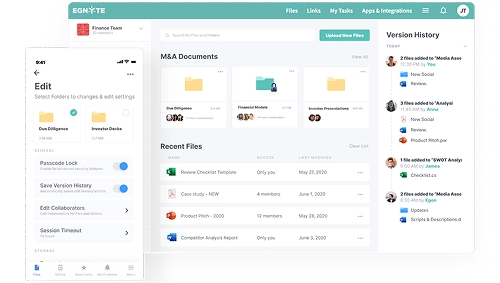
Controlled External File Sharing
Share sensitive files with outside parties quickly, securely and with full control.