
AI-Powered Document Analysis for Legal & Compliance Teams
Legal and compliance teams are drowning in documents like contracts, audit reports, policy updates, and regulatory filings. Every file needs to be reviewed, sorted, and stored properly. But when teams rely on manual processes and scattered systems, it’s easy to miss deadlines, misplace critical information, or fall out of compliance.
The risk isn’t just operational but legal and financial as well.
However, when integrated with a secure data collaboration platform, AI-powered document analysis offers a scalable and auditable solution. From automatically classifying documents to extracting key terms and clauses, these tools enable teams to move faster, stay audit-ready, and minimize errors.
This article explores the core challenges of traditional document review and how AI-driven tools enhance legal document automation and compliance document management.
Let’s jump in and learn:
- Key Takeaways:
- Challenges in Traditional Legal Document Review
- Key Capabilities of AI-Powered Document Analysis Tools
- Why AI Matters for Legal and Compliance Teams
- Practices for Implementing AI Document Analysis
- This is How Egnyte Can Help You
- Case Studies and Success Stories
- Conclusion
- Frequently Asked Questions:
Key Takeaways:
- Legal and compliance teams struggle with high document volume, manual review, and error risks, making traditional processes slow and inconsistent.
- AI-powered document analysis automates classification, clause extraction, risk detection, and contract review to improve accuracy and speed.
- AI enables real-time compliance monitoring, reduces human error, cuts review costs, and strengthens audit readiness across legal operations.
- Egnyte supports this transformation with secure content management, AI-driven insights, and compliance automation to help teams stay efficient and fully governed.
Challenges in Traditional Legal Document Review
Here are some of the challenges often faced in traditional legal document review, which makes intelligent document extraction difficult, unscalable, and non-compliant.
Volume and Complexity of Documents
Legal and compliance teams handle massive volumes of unstructured, jurisdiction-specific documents, including contracts, filings, and audit records. The presence of complex clauses, cross-references, and varied formatting makes traditional review processes inefficient. Without intelligent document extraction, standardization and timely analysis become increasingly difficult.
Time-Consuming Manual Processes
Manual document review consumes a significant amount of time and legal resources. Teams must search for critical clauses, flag deviations, and ensure regulatory alignment: Tasks that slow down decision-making and increase operational overhead. Automating these workflows through legal document automation significantly streamlines compliance document management.
Risk of Human Error
Manual workflows are also highly susceptible to oversight. Missed clauses, outdated policy language, or inconsistent redlines can lead to compliance violations. Leveraging compliance automation software helps mitigate these risks by enforcing consistency and enabling real-time error detection across large document sets.
Key Capabilities of AI-Powered Document Analysis Tools
AI-powered document analysis tools integrate advanced technologies to streamline legal document automation and strengthen compliance document management.
Natural Language Processing (NLP)
NLP enables accurate clause detection by analyzing legal language in context. It identifies obligations, indemnities, and termination terms, outperforming basic keyword searches. Transformer models, such as BERT, have significantly enhanced clause classification and segmentation across various document types.
Machine Learning Algorithms
Trained on legal corpora, machine learning models classify documents ( NDAs, DPAs), extract key entities, and detect anomalies. These algorithms continuously adapt through feedback, improving accuracy in identifying deviations from standard policies.
Automated Contract Review
AI tools automate contract review by comparing documents against internal playbooks, flagging discrepancies, and recommending redlines. This reduces review time by over 60% while ensuring internal compliance standards are enforced across all agreements.
Risk Detection and Compliance Monitoring
Compliance automation software utilizes AI to identify risks, including outdated clauses, missing disclosures, or unapproved terms. Risk scoring enables legal teams to prioritize issues and maintain real-time visibility into regulatory exposure.
Feature | Technical Capability | Key Outcomes |
NLP Parsing & Entity Recognition | Clause segmentation, anaphora resolution, and semantic tagging | Enable syntactic understanding, structured representation, and ambiguity resolution Accurate clause identification and extraction |
Machine Learning Classification | Contract type detection, anomaly detection, and clause benchmarking | Reduced manual classification and error detection |
Automated Contract Review | Playbook comparison, redlining, templating | Faster review cycles, standardized compliance enforcement |
Risk and Compliance Monitoring | Real-time flagging, scoring models, and historical trend analysis | Early risk detection, audit readiness, and policy enforcement |
Why AI Matters for Legal and Compliance Teams
AI-powered document analysis delivers strategic benefits across legal operations like:
Faster Legal Workflows
According to Gartner (2024), nearly 40% of in-house legal and compliance teams are now piloting or deploying generative AI tools. AI automates time-consuming tasks like clause tagging, document classification, and contract comparison.
For example, when reviewing a batch of NDAs or vendor agreements, AI can instantly extract key terms like jurisdiction, termination clauses, or indemnities, without human input. This reduces contract turnaround times by 50–70%, helping legal teams process more work without bottlenecks. It’s especially effective for routine documents where both speed and accuracy are important.
Reduced Errors, Greater Consistency
Manual legal review often varies depending on who’s reviewing the document and how much time they have. AI eliminates this inconsistency. Once trained on your internal templates and clause libraries, it applies the same review logic every time, ensuring that risky language, outdated terms, or missing disclosures are consistently flagged. This is critical in industries where even minor errors can lead to regulatory fines or contract disputes.
Real-Time Compliance Monitoring
AI tools can be integrated with your document repository or contract lifecycle platform to continuously scan for red flags, such as expired clauses, unapproved terms, or missing policy acknowledgments. Instead of relying on periodic manual audits, teams can monitor compliance status in real time, across thousands of files. This supports faster internal audits, regulatory readiness, and more vigorous enforcement of internal controls.
Cost Optimization
AI doesn’t replace legal professionals; it enables them to do more with less. By automating repetitive and low-value tasks (like scanning documents for clause presence or checking for standard language), teams can reallocate senior lawyers to strategic work like negotiations, litigation planning, or advisory support. Over time, this translates into measurable savings in external counsel costs and improved legal throughput without increasing headcount.
Practices for Implementing AI Document Analysis
Implementing AI-powered document analysis demands alignment with existing legal workflows, user adoption strategies, and robust security protocols. To fully realize the benefits of legal document automation and compliance document management, organizations must integrate AI tools thoughtfully and securely.
Integration with Existing Legal Workflows
AI tools should integrate seamlessly with contract lifecycle management (CLM) systems, document management systems (DMS) platforms (e.g., SharePoint, iManage), and compliance dashboards. Built-in connectors enable clause analysis and risk scoring to occur directly within existing workflows, minimizing disruption.
A good practice is to choose platforms with native integrations to avoid workflow friction.
Training and Adoption by Legal Teams
Adoption depends on trust and usability. Legal teams require training on AI-generated outputs, particularly in areas such as clause interpretation and risk scoring. Starting with pilot use cases (e.g., NDA review) builds familiarity and ensures oversight through manual overrides.
An effective strategy is to pair technical onboarding with real-world examples, which can improve confidence and control.
Ensuring Data Security and Privacy
AI tools must adhere to strict data governance, with encryption, access control, and audit logs being essential components. Ensure compliance with standards like ISO 27001, SOC 2 Type II, and GDPR, especially in regulated industries. On-premise or hybrid models help meet data residency laws.
Don’t forget to vet vendors for legal privilege protection and regulatory certifications.
This is How Egnyte Can Help You
Egnyte provides a secure, AI-powered platform tailored for legal and compliance teams seeking scalable legal document automation and effective compliance document management. By combining intelligent content classification, automated risk detection, and enterprise-grade security, Egnyte enables legal operations to stay compliant, audit-ready, and efficient.
- Centralized Document Management
- AI-Driven Clause Extraction & Risk Detection
- Compliance Automation Software Integration
- Seamless Workflow Integration
- Enterprise-Grade Security
Egnyte delivers end-to-end control and visibility, making it a reliable partner for managing sensitive legal content and meeting complex regulatory demands.
Case Studies and Success Stories
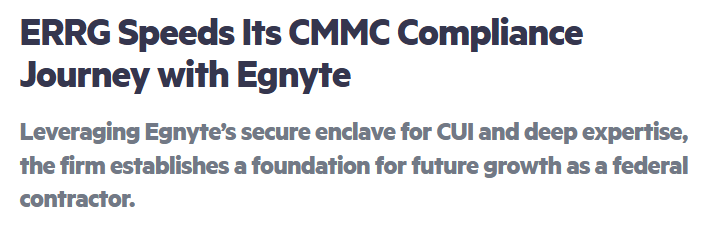
Challenge
ERRG, a federal contractor generating ~80% of revenue from DoD work, faced imminent CMMC 2.0 compliance deadlines and had experienced a ransomware attack in 2021. Their legacy SharePoint environment was cumbersome, insecure, and not CMMC‑ready. They needed a system that would enhance the security of Controlled Unclassified Information (CUI) without disrupting engineering workflows.
Solution
Within a month, ERRG migrated from on‑prem SharePoint to Egnyte’s secure cloud platform. They implemented:
- Sensitive data discovery and classification, enabling robust identification of CUI across repositories.
- Granular access and sharing controls, aligning file permissions with CMMC requirements while preserving operational ease.
Immediately measurable results included:
- Achieved ~90% of CMMC 2.0 requirements on schedule, with full compliance expected before deadlines.
- Strengthened data security posture, reducing ransomware risk and compliance penalties.
- Enabled secure file sharing with minimal workflow disruption and ongoing guidance from Egnyte’s CMMC‑experienced team.
Read more here
Conclusion
The shift from manual legal reviews to AI-powered document analysis is both a strategic and operational transformation. As legal and compliance teams grapple with rising volumes of unstructured, high-stakes documentation, traditional workflows are no longer sustainable.
With the right systems in place, organizations can reduce operational burden, enhance regulatory visibility, and move toward proactive governance. This foundation not only improves accuracy and speed but also ensures audit readiness and long-term adaptability.
Egnyte stands out as a purpose-built platform supporting this evolution. Through its unified architecture for secure file access, AI-powered classification, and compliance automation software, Egnyte enables legal and compliance teams to operate from a single, governed content layer, regardless of whether they work across cloud, hybrid, or regulated environments. The result is durable operational intelligence: compliant, scalable, and aligned with enterprise legal strategy.
Frequently Asked Questions:
Q. Can AI tools be customized to recognize industry-specific legal terminology or clauses?
Yes. AI-powered document analysis platforms use customizable NLP and machine learning models trained on industry-specific corpora. This enables reliable clause identification across sectors like healthcare, finance, and construction, improving legal document automation at scale.
Q. What types of legal documents can benefit most from AI-powered analysis?
High-volume, compliance-sensitive documents benefit most, such as NDAs, MSAs, employment contracts, regulatory filings, and DPAs. AI extracts key legal and contract terms.
Q. How can legal teams ensure a smooth transition from manual to AI-assisted document review?
Start with pilot use cases and choose platforms that integrate with existing compliance document management systems. Prioritize transparency, provide training, and use vendors experienced in compliance automation software to build trust and adoption.
Q. What data privacy considerations should legal teams keep in mind when using AI tools?
Ensure AI tools adhere to enterprise-grade standards, including encryption, access controls, and audit logging. Use compliance automation software certified under ISO/IEC 27001, SOC 2 Type II, and aligned with GDPR, HIPAA, and other data residency regulations.
Egnyte has experts ready to answer your questions. For more than a decade, Egnyte has helped more than 23,000+ customers with millions of users worldwide.
Additional Resources

Automated Data Governance
Streamline compliance and boost efficiency with automation.

Data Governance Frameworks & Tools
Explore key frameworks and tools to ensure compliance and strengthen governance.

AI and Data Security
Learn how AI enhances data protection and mitigates security risks.