
How Intelligent Workflow Automation Enhances Business Decision-Making
Business decisions are only as strong as the workflows behind them. As operations scale and data volume grows, the need for faster, more consistent decision-making has pushed intelligent workflow automation from a back-office utility to a core strategic function.
Powered by AI, today’s automation platforms do more than remove manual steps: They analyze, prioritize, and trigger decisions across functions like finance, compliance, operations, and customer service. For example, a transportation agency used digital-twin modelingto optimize traffic decisions without disrupting live infrastructure.
Analysts estimate intelligent decision automation can reduce operational friction by up to 35% and shorten decision cycles by nearly 30%.
In this article, we’ll look at how AI-powered workflow systems are shaping faster, smarter decisions, what the architecture looks like, how to implement it, and what benefits to expect when it’s done right.
Let’s jump in and learn:
- Key Takeaways:
- Components of Intelligent Workflow Automation
- Benefits of Intelligent Workflow Automation for Decision-Making
- How Intelligent Workflow Automation Works in Businesses
- Use Cases of Workflow Automation in Business Decision-Making
- Challenges and Considerations When Implementing Workflow Automation
- This Is How Egnyte Helps You
- Case Studies and Success Stories
- Conclusion
- Frequently Asked Questions:
Key Takeaways:
- Intelligent workflow automation uses AI, RPA, and system integrations to speed up decision-making and remove manual, error-prone tasks.
- These systems improve data quality, enable real-time insights, and convert business events into fast, proactive decisions.
- Adoption challenges such as legacy systems, compliance risks, and resistance to change can be solved with integrations, governance, and secure automation practices.
- Egnyte supports this transformation by unifying content, automating classification, enabling AI-driven workflows, and delivering secure, real-time decision intelligence.
Components of Intelligent Workflow Automation
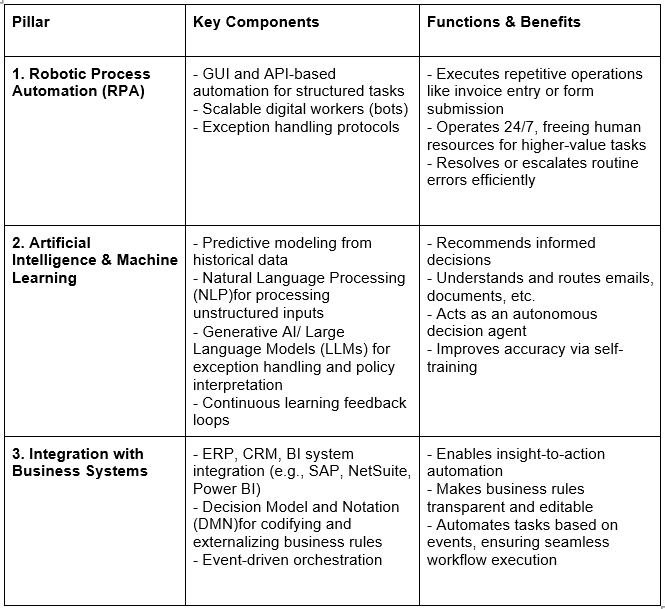
Benefits of Intelligent Workflow Automation for Decision-Making
Integrating intelligent workflow automation and automated decision-making systems delivers quantifiable advantages across four core impact areas:
- AI workflow automation replaces fragmented hand-offs with event-driven bots, letting capacity grow with demand instead of headcount, leading to increased productivity and efficiency.
- Intelligent workflow automationblends data-quality rules and machine learning to cleanse and enrich information in real-time, generating actionable insights from data and enhancing overall data accuracy and insights.
- Embedded predictive engines in automated decision-making systems convert business events into instant, data-driven actions for agile, proactive decisions.
- Deterministic workflow automation software eliminates manual errors and enforces compliant execution with built-in audit trails and role-based access control (RBAC).
The outcome is a data-to-decision pipeline that supports proactive intervention and agile responses to market changes.
How Intelligent Workflow Automation Works in Businesses
Intelligent workflows blend AI, Robotic Process Automation (RPA), and system integration to unlock automated, secure, insight-driven operations. Here’s how they function:
1. Data Collection & Processing
- Automated ingestion: Streaming pipelines (e.g., Apache Kafka, AWS Kinesis) collect structured and unstructured data, including transaction logs, sensor feeds, emails, and so on, in real-time.
- Data cleansing & normalization: RPA bots and Machine Learning (ML)-driven routines standardize formats, detect anomalies, and enrich records within secure cloud storage solutions, resulting in data integrity at the source .[NJ1]
- Metadata tagging: NLP tags and classifies incoming content (invoices, support tickets), throughout the content lifecycle, creating semantic indexes for intelligent downstream processing.
2. Automated Task Management
Automated task management turns static queues into dynamic, rule-driven workflows. Bots assign, prioritize, and execute tasks securely while maintaining full auditability. Below are the features:
- Task orchestration - Bots schedule and route tasks based on priority rules & predictions
- Priorities & SLAs - Tasks auto-prioritized based on urgency, risk, or operational metrics
- Secure execution - Encrypted task context is preserved in the cloud, enabling audit-ready paths
3. Real‑Time Analytics & Reporting
- Streaming analytics: Connectors like Kafka → MongoDB or Apache Flink process incoming streams, generating metrics and Key Performance Indicators (KPIs) within milliseconds .
- Dashboards & visualization: Tools ingest this “hot” data to power real-time Business Intelligence (BI) dashboards, alerting executives to KPIs that exceed thresholds.
- Model retraining: Behind the scenes, ML pipelines automatically consume new data from analytics and retrain recommendation engines for higher accuracy.
4. Intelligent Alerts & Recommendations
- Rule- and ML-driven alerts:
- CB fraud: Transactions trigger alerts when deviating from patterns.
- Equipment health: Sensor anomalies raise predictive maintenance flags.
- Contextual recommendations:
- AI agents can be trained to propose[SK1] next-best-payments, inventory replenishment triggers, or legal template selections based on analyzed data.
- Secure distribution: Alerts are pushed via encrypted channels with contextual attachments stored in secure cloud storage solutions.
Use Cases of Workflow Automation in Business Decision-Making
Finance & Accounting:
- Invoice & Expense Processing
AI and Intelligent Document Processing (IDP) identify, extract, and validate invoice data, reducing manual intervention and accelerating close cycles - Anomaly Detection & Forecasting
Financial teams deploy automated decision-making systems to flag unusual transactions and forecast cash flows. - Collateral & Risk Assessment
Gen-AI models streamline collateral review, anti-money laundering checks, and credit risk assessments, reducing manual review time and improving consistency.
Customer Service:
- Ticket Triage & Routing
NLP-based bots analyze and classify incoming tickets (e.g., FAQs, complaints), escalating only complex cases to agents. - Proactive Chatbots & Co‑pilots
Chatbots and generative-AI co-pilots interact with customers across channels 24/7, resolving common queries instantly and boosting satisfaction. - Personalized Recommendations
Systems analyze customer profiles and past interactions to deliver tailored suggestions (products, service plans), increasing responsiveness and engagement .
Supply Chain & Operations:
- Document Processing in Logistics
AI-powered systems ingest bills of lading, customs declarations, and invoices. - Order Status Automation
RPA bots monitor order updates and automatically notify internal teams and customers of delays or changes, in real-time. - Procurement & Inventory Optimization
Machine learning optimizes sourcing, dynamic routing, warehouse slotting, and replenishment decisions: improving responsiveness to variance or disruptions. - Warehouse Automation & Traceability:
Unmanned Aerial Vehicles (UAVs)- commonly referred to as drones- and autonomous systems scan and trace inventory using Radio Frequency Identification (RFID) and the blockchain, enabling fast, secure, and auditable inventory tracking.
Challenges and Considerations When Implementing Workflow Automation
Successfully implementing intelligent workflow automation requires solving real-world enterprise challenges with secure, adaptable systems. Below are common roadblocks and their corresponding solutions.
1. Legacy Systems Lack Application Programming Interfaces (APIs)
Older platforms often lack modern APIs, making it difficult to integrate bots and workflows.
Solution: Use middleware or API wrappers to enable data exchange. Egnyte simplifies integration with legacy and modern systems through flexible connectors and a robust API ecosystem, ensuring secure, scalable data flow.
2. Organizational Resistance to Change
Without buy-in, automation becomes shelfware. Teams may resist if they don’t trust the outputs.
Solution: Pilot with specific roles, provide targeted training, and identify automation champions. Tie every workflow to a measurable KPI. Egnyte’s intuitive dashboards help visualize ROI, reinforcing trust and strategic alignment.
3. Compliance Risk in Automation
Automating decisions—especially with sensitive data—raises serious compliance concerns (e.g., GDPR, HIPAA, PCI-DSS).
Solution: Enforce Security by Design. Egnyte supports RBAC, AES-256 encryption, immutable audit logs, and secure cloud storage, so that automated workflows meet enterprise-grade compliance from day one.
4. Shadow IT and Siloed Automation
Isolated automation efforts can lead to redundant tools, inconsistent standards, and governance gaps.
Solution: Establish a Center of Excellence (CoE) to define standards and manage deployment. Egnyte’s centralized governance tools and usage analytics prevent data and device sprawl and provide full visibility across departments.
5. Static Models and Inefficient Bots
Without feedback, automation degrades over time, delivering outdated or inaccurate decisions.
Solution: Implement Continuous Integration & Continuous Delivery (CI/CD) and Machine Learning Operations (MLOps) practices to continuously update models. Egnyte enables real-time tracking, versioning, and policy updates to ensure workflows adapt dynamically as business needs evolve.
6. Limited Adoption and Skill Gaps
Automation stalls when only developers can maintain bots.
Solution: Empower citizen developers through low-code tools. Egnyte’s user-friendly interface and integration with common platforms (e.g., Microsoft 365, Salesforce) allow teams to build and iterate workflows without coding expertise.
This Is How Egnyte Helps You
Here’s how Egnyte transforms raw content into actionable intelligence, using intelligent workflow automation, AI workflow automation, and secure cloud storage solutions:
- Egnyte unifies files from on-prem, cloud, and third-party data stores [NJ1] into a single secure cloud storage solution, eliminating silos so that manual users and intelligent workflow automation pipelines can access content without friction.
- Embedded AI engines auto-classify and tag documents, surface anomalies, and trigger no-code workflows, turning raw files into governed assets that feed automated decision-making systems.
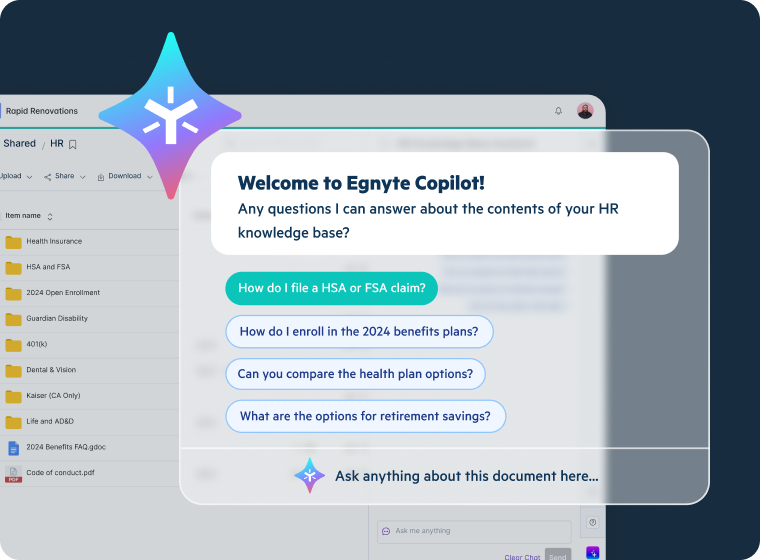
- Conversational Copilot and live telemetry layer real-time dashboards, summaries, and insights on top of your repository, delivering immediate actionable insights from data for compliance, optimization, and strategic planning.
- Security by Design ensures AI workflow automation runs safely across hybrid and multi-cloud environments while meeting stringent data governance requirements.
Case Studies and Success Stories
Here are two real-world examples showcasing how Egnyte's intelligent workflow automation and secure cloud storage solutions drive measurable business transformation.
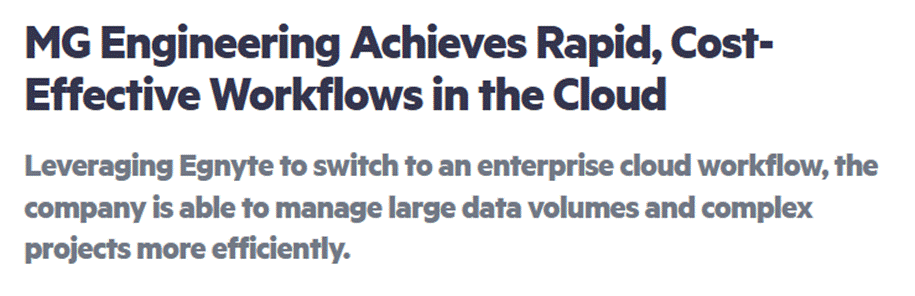
Challenge
An engineering firm managing hundreds of simultaneous projects, with upwards of 20 TB of CAD data, faced inefficiencies due to hybrid file storage and frequent versioning issues. Time-consuming manual backups, slow file transfers, and inconsistent document access hindered both team productivity and project delivery.
Solution
The firm adopted a fully cloud-first file-management workflow in Egnyte. Instead of syncing 20 TB of data back to local servers, all content now resides in Egnyte’s enterprise cloud, which handles very large Autodesk CAD files with minimal latency. Native integrations—most notably with Autodesk and mxHERO—let engineers open, share, and version drawings directly, while Outlook attachments are automatically off-loaded to Egnyte to free mail-server space.
Measurable outcomes include:
- Over $50,000 saved annually through reduced server infrastructure and IT effort
- Thousands of staff-hours redirected from manual tasks to higher-value engineering work
- Folder structures created in ~30 seconds instead of 15 minutes
- Faster, reliable access to large files across global project teams
Read more here
Challenge
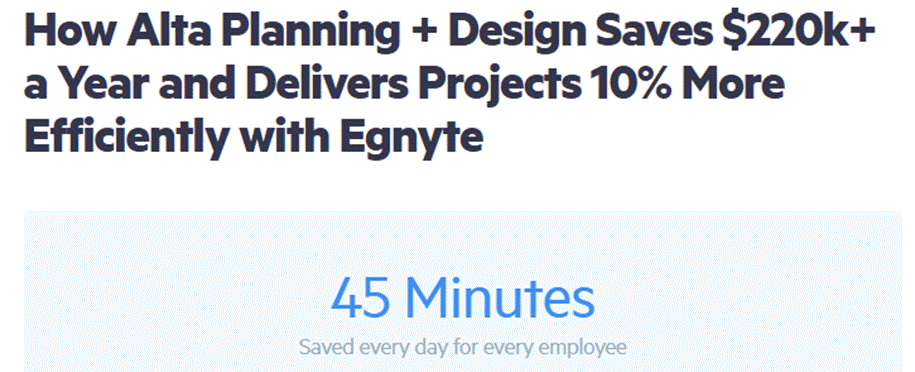
A global outdoor services organization with numerous regional offices struggled with legacy file servers and disparate storage locations. Employees lost an average of 30 minutes daily searching for resources, and IT support was strained by broken links, missing files, and siloed storage. These issues cost time, money, and morale.
Solution
Egnyte replaced NAS servers with a hybrid cloud platform that provided secure, always-on access to content. AI-enabled synchronization ensured that distributed teams always had the latest files. Built-in analytics and audit logging improved data visibility and governance. Integration with CRM and content tools enabled seamless workflows across systems.
Immediate and tangible outcomes of Egnyte’s solutions include:
- $220K+ annual savings from time efficiencies and IT cost reduction
- Average billable user saved >30 minutes daily
- Collaborative editing and file access accelerated by 10%
- 40% reduction in IT support efforts and $81.5K+ in server maintenance savings
- Enhanced data security through centralized access and audit trails
Read more here
Conclusion
With the right systems in place that support insights extraction & content intelligence, businesses can eliminate data fragmentation, enhance compliance, and build AI-ready ecosystems. In doing so, they not only achieve operational efficiency and agility but also future-proof themselves against evolving demands in governance, security, and innovation.
Egnyte’s unified platform combines secure cloud storage solutions with hybrid collaboration, layers in AI workflow automation for metadata classification, Copilot-driven assistance, and automated decisions to enforce real-time governance through anomaly detection and compliance controls: all on a single, trusted content layer. This permits distributed teams to generate actionable insights from data and work seamlessly.
Frequently Asked Questions:
Q. What types of organizations can benefit most from intelligent workflow automation?
Any business overloaded with repetitive, data-intensive tasks can gain from intelligent workflow automation. Enterprises that manage large volumes of unstructured content and Small & Medium-Sized Businesses (SMBs) that run workflow automation software with secure cloud storage solutions also see faster processes, lower costs, and more capacity for growth.
Q. Can intelligent workflow automation be tailored to specific industries or departments?
Yes. Modern AI workflow automation platforms are modular: connectors, rule engines, and ML models can be configured for Know Your Customer (KYC) initiatives in finance, claims in insurance, contract review in legal, or ticket triage in IT. This flexibility enables each business unit to run domain-specific, automated decision-making systems without heavy, customized code.
Q. What obstacles arise during automation projects, and how can they be overcome?
Common hurdles include legacy systems lacking APIs, change resistance among users, and heightened security demands. Middleware and staged rollouts smooth technical friction; stakeholder pilots, training, and user involvement boost adoption; encryption, RBAC, and audit logging help to embed compliance protection from day one.
Q. How can companies manage regulatory compliance while automating workflows?
Embed compliance into design: store data in secure cloud storage solutions with encryption at rest and in transit, enforce Role-Based Access Control (RBAC) and Multi-Factor Authentication (MFA) for access, log every automated action immutably, and run continuous policy checks so workflows stay aligned with GDPR, HIPAA, PCI-DSS, and similar standards.
Egnyte has experts ready to answer your questions. For more than a decade, Egnyte has helped more than 22,000+ customers with millions of users worldwide.
Additional Resources

Cybersecurity in the Age of AI
Explore how AI is reshaping cybersecurity strategies for financial services, from threat detection to compliance.

Egnyte Copilot
AI-powered assistant that helps users find, summarize, and manage content securely across Egnyte.
CMMC Assessment Prep with Egnyte
Watch how Egnyte helps organizations streamline compliance and prepare for CMMC assessments with practical tools and ...