
SECURE ENCLAVE SOLUTION
GDPR and CCPA Compliance
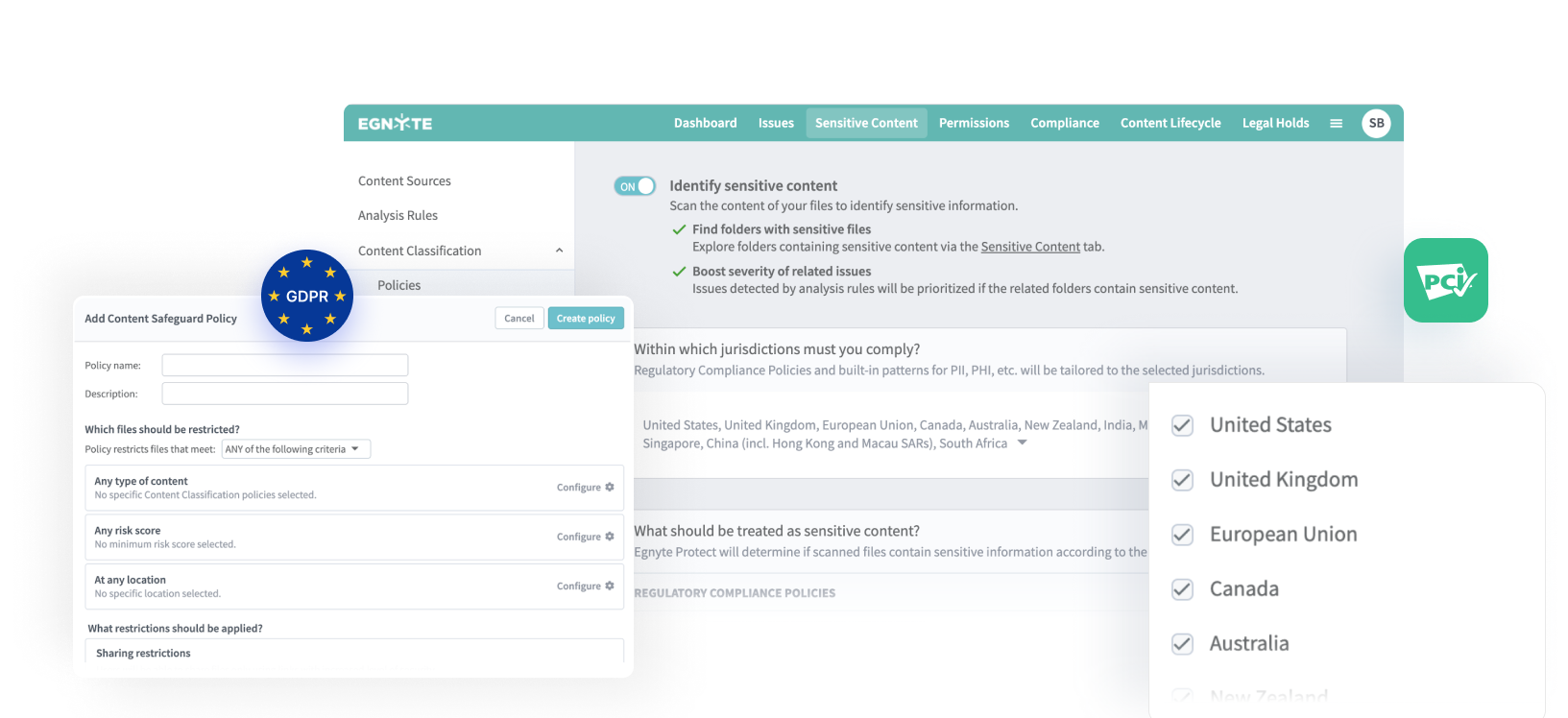
All-In-One Solution For GDPR and CCPA
Govern Company-Wide Data
- Scan data across any repository
- Classify and tag files containing personal information
- Measure and report on privacy programs

Reduce Privacy Risk Exposure
- Create and enforce privacy controls
- Enable consumers to exercise their privacy rights
- Improve audit defensibility

Achieve Compliance With Less Overhead
- Apply 100s of pre-built compliance patterns with just one click
- Scale up for new regulations and increasing consumer request volume, without adding cost or complexity
- Leverage Egnyte’s deep industry expertise
The Egnyte Solution
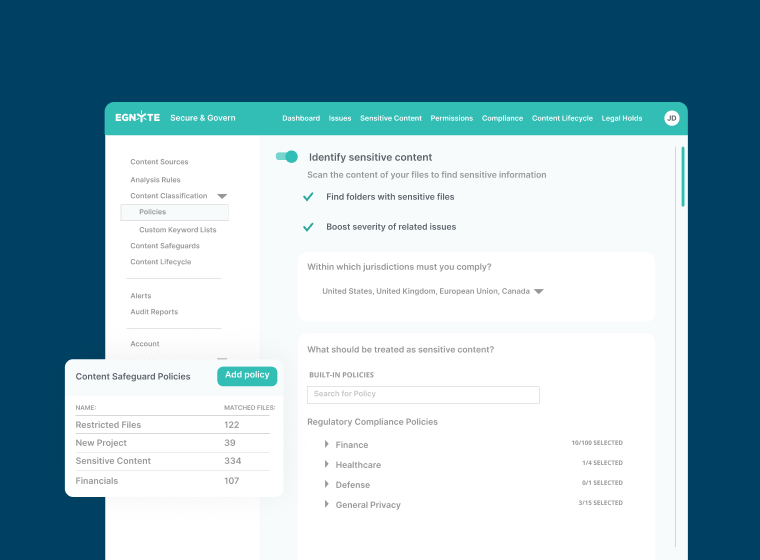
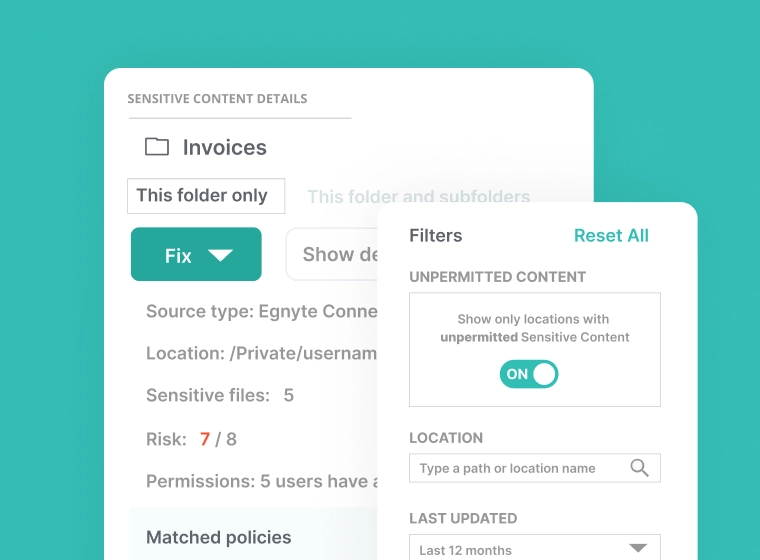
Identify And Label Personal Data
- Data Discovery: Locate personal data across structured, unstructured and semi-structured silos
- Data Classification: Use AI to automatically attach metadata (tags or labels) to files, folders, or databases containing sensitive information
- Data Mapping: Monitor data flows programmatically, and prioritize risks and mitigation activities
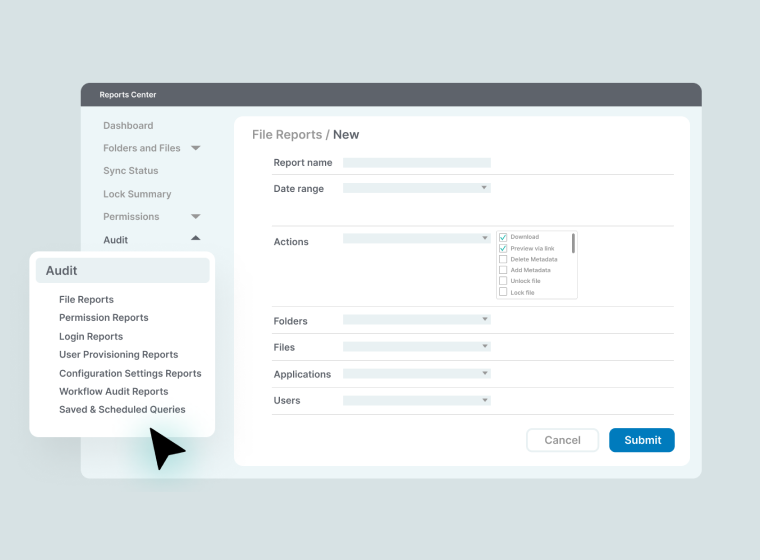
Control Personal Data
- Purpose-Based Access Control: Establish granular, content- and context- aware access controls over personal data
- Record Keeping: Maintain logs of who has accessed sensitive content, and what they did with it
- Lifecycle Management: Delete content that is redundant, obsolete or trivial (ROT) and enforce “end of life” policies
- PII Protection: Scramble, hash, encrypt, and over-write privileged PII
- Localization: Restrict file storage and/or access to defined geographies
Fulfill Compliance Obligations
- Incident Response: Swiftly assess whether an incident could trigger a breach disclosure and initiate a series of privacy-specific activities if required
- SAR/DSAR Fulfillment: Automate intake and response for subject access requests
- Consent Management: Provide transparency and choices over how personal data should be handled
- Privacy Impact Assessments (PIAs): Develop and track PIAs through predefined workflows
Join the Conversation
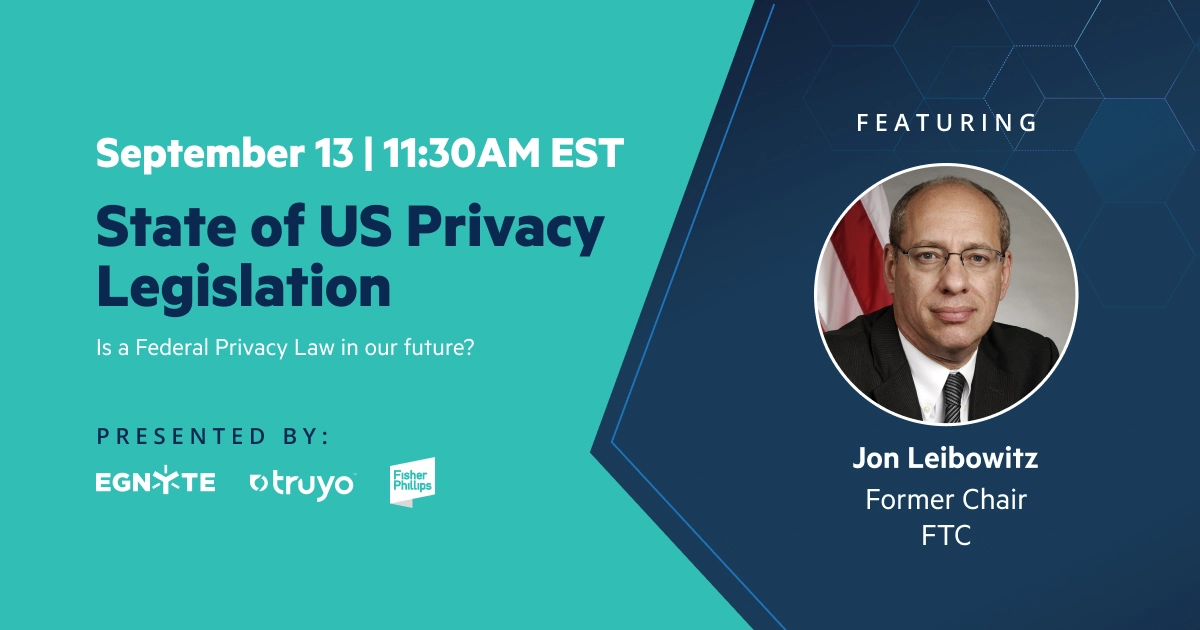
On September 13, 2022, Egnyte co-hosted a live virtual event with data privacy experts including former FTC Chairman Jon Leibowitz. The discussion addressed the implications of recent and upcoming U.S. state and federal legislations. Watch the replay on demand.
Start Improving Your Data Privacy Posture Today
Contact Solution SpecialistFAQs
GDPR uniformly strengthened individuals' data privacy rights in the European Union(EU). It also reduced the compliance burden for companies and public entities, by providing a single set of rules for all EU member states to follow.
Previously, all member states enacted their own data protection legislation, resulting in uneven data privacy protection across member countries. Separate member state requirements also made regulatory compliance challenging for companies impacted by the standards. Learn more about GDPR compliance requirements with this guide.
GDPR’s reach is expansive: Any company that stores or processes personal information about European Union (EU) citizens or persons who are present in the EU must comply with GDPR, regardless of the company’s size. The company doesn’t need to have a business presence within the EU to be subject to the regulation.
The following information is current as February 2026:
- Under GDPR Article 83 (4), less severe compliance violations can result in fines up to 10 million euros, or 2% of the firm's worldwide annual revenue from the preceding financial year, whichever is higher.
- Under GDPR Article 83 (5), more serious infringements that violate GDPR’s principles of the right to privacy and the right to be forgotten can result in fines of up to 20 million euros, or 4% of the firm's worldwide annual revenue from the preceding financial year, whichever is higher.
Read more about GPDR’s requirements in this guide to stay compliant.
At their core, both data privacy regulations are significant. The CPRA expanded data privacy protections beyond the CCPA by:
- Raising the compliance threshold to 100,000 consumers and covering companies that share personal data, not only those that sell data
- Establishing a dedicated enforcement agency, the California Privacy Protection Agency (CPPA)
- Removing the automatic 30-day grace period for potential compliance violations
Learn more about the differences between these regulations with our CPRA guide.
Not all businesses need to comply with the CPRA. As of February 2026, CPRA compliance is required if your company generates gross revenue of more than $25 million a year, handles data of 100,000 or more consumers/households, or makes at least 50% of its revenue from selling personal information.
As of February 2026, monetary damages (charged per consumer/per data breach incident) range from $107 per consumer/ incident to $799 per consumer/incident. Administrative fines, civil penalties, and daily compensation rates for board members also apply. Complete details are available on the California Privacy Protection Agency’s Website.
Yes, classification of sensitive information (including CPRA and GDPR data) can be performed with AI-powered data governance platforms like Egnyte.
In particular, you can detect PHI and PII that isn’t adequately protected and move it to a more secure location. Watch this product tour to learn more about how data classification works.