
Cloud vs On-Premise Data Governance: What Works Best Today?
The choice between cloud vs on-premise enterprise data governance is one of the most important decisions for any business managing sensitive or regulated content. It affects how they handle security, control costs, meet compliance requirements, and support remote teams.
Here we break down what’s working best right now based on facts, not assumptions, so that you can make the right call for your data strategy.
Let’s jump in and learn:
- TL;DR: How Cloud and On-Prem Data Governance Compare in 2025
- What is Data Governance?
- Cloud Data Governance
- On-Premise Data Governance
- Difference Between Cloud vs On-Premise Data Governance
- Difference Between Cloud vs On-Premise Data Governance
- Challenges of Cloud Data Governance
- Key Benefits of On-Premise Data Governance
- Challenges of On-Premise Data Governance
- All About Egnyte's Cloud Data Governance
- Case Studies and Success Stories
- Conclusion
- Frequently Asked Questions
TL;DR: How Cloud and On-Prem Data Governance Compare in 2025
- Data governance ensures accuracy, consistency, security, accessibility, and accountability across an organization while supporting compliance.
- Cloud data governance offers scalability, cost efficiency, real-time access, and easier collaboration for remote or distributed teams.
- On-premise solutions provide full control, customization, and direct oversight of security and regulatory compliance but require higher costs and maintenance.
- Cloud solutions may face vendor lock-in, security risks, and regulatory challenges, whereas on-premise setups have limited flexibility and slower deployment.
- Egnyte’s platform unifies content management, enforces security, supports compliance, integrates with enterprise tools, and helps organizations like Wintrust and MOMA improve efficiency and data governance.
What is Data Governance?
Data governance is the process of overseeing the availability, integrity, usability, and security of data within an organization. It includes policies and standards that ensure data is accurate, consistent, and accessible to the right users.
Effective governance reduces risk, supports compliance, and enables faster, informed decision-making. It also establishes data ownership and accountability across the business.
Cloud Data Governance
Cloud data governance manages data policies in cloud environments, using scalable technologies to store, process, and protect information.
This model supports dynamic data workloads and makes it easier to roll out governance controls across multiple teams and regions. Cloud governance tools also integrate with AI-driven analytics and automation to automate classification, enforce compliance, and detect anomalies at scale.
On-Premise Data Governance
On-premise data governance involves managing data within the internal infrastructure. It offers expansive control over storage, processing, and security.
This approach is ideal for industries with strict regulatory demands, like healthcare, government, and finance. It also allows for deeper customization of security protocols, which is critical for organizations with specialized operational or legal needs.
Difference Between Cloud vs On-Premise Data Governance
When comparing cloud vs on-premise data governance, the differences go beyond just where the data lives. Each model impacts cost, control, scalability, security, and how easily teams can access and manage data.
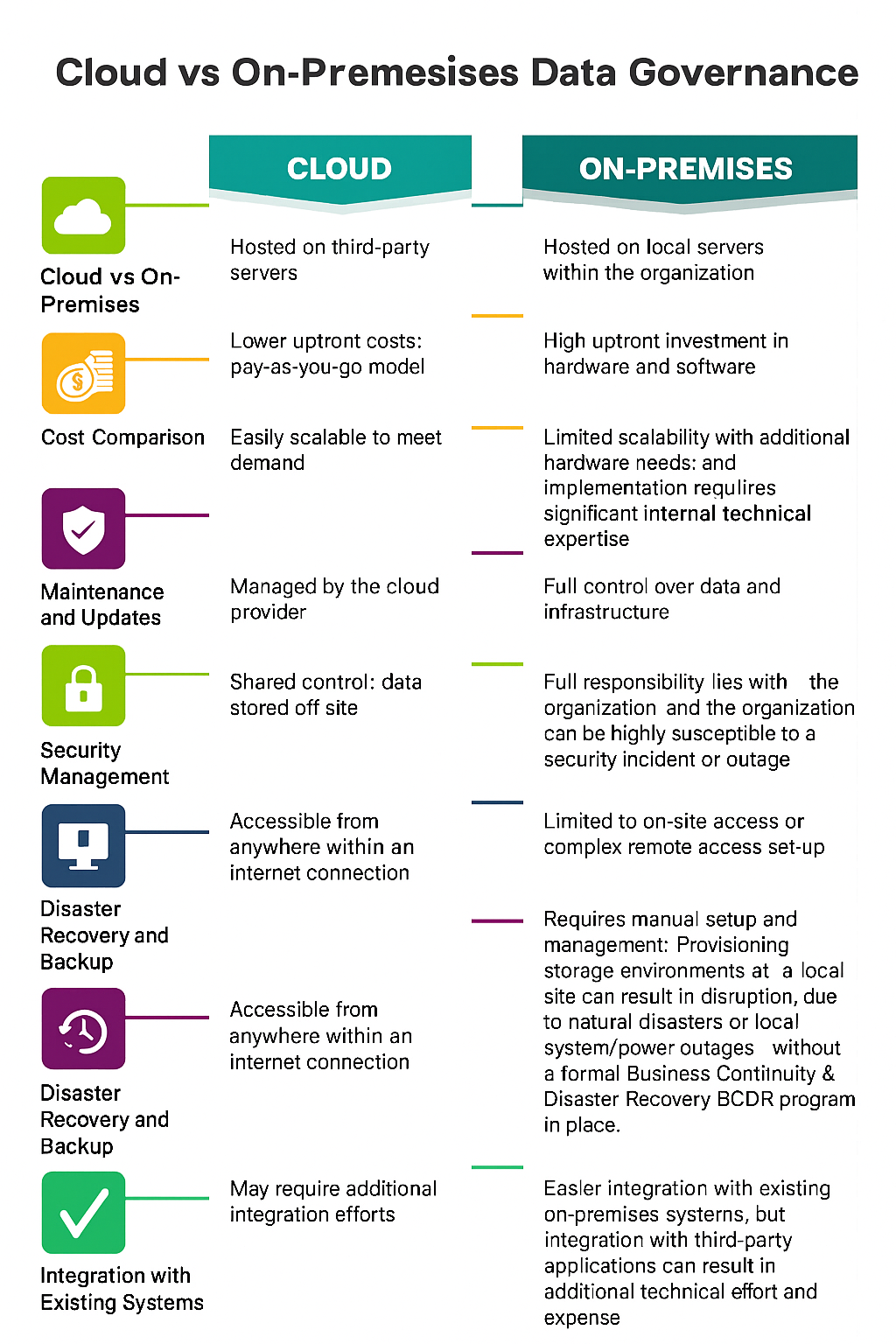
Difference Between Cloud vs On-Premise Data Governance
Cloud data governance offers several practical advantages that align with how modern businesses operate today. They directly impact productivity, cost, and speed of execution.
Your organization can accomplish the following:
Scalability and Flexibility
- Easily adjust resources to meet changing demands.
- Support rapid deployment of new applications and services.
Cost-Effectiveness and Reduced IT Overhead
- Lower upfront costs with subscription-based pricing.
- Reduce the need for extensive in-house IT infrastructure and staff.
Real-Time Access and Collaboration
- Enable remote access to data and applications.
- Facilitate collaboration across geographically dispersed teams.
Challenges of Cloud Data Governance
While cloud data governance brings speed and flexibility, it can also introduce new risk that your organization must manage carefully, unless you work with a proven technology provider. These challenges often involve security gaps, regulatory complexity, and long-term dependencies on specific vendors.
Data Security and Privacy Concerns
- Potential risk associated with storing data off-site.
- Dependence on the cloud provider's security measures.
Vendor Lock-In and Compliance Issues
- Challenges in migrating data between providers.
- Managing compliance with various regional and industry-specific regulations.
For all of these reasons, you need to engage with an experienced technical partner that possesses deep experience in regulatory compliance and data security.
Key Benefits of On-Premise Data Governance
On-premise data governance offers significant advantages for organizations that prioritize control, customization, and regulatory alignment. It’s especially valuable where data sensitivity, legacy infrastructure, or strict internal policies demand tight oversight.
Complete Control Over Data and Infrastructure
- Complete ownership and control over data storage and processing.
- Ability to customize infrastructure to specific organizational needs.
Enhanced Security and Compliance
- Direct oversight of security measures and protocols.
- Easier to meet very specialized regulatory and compliance requirements.
Challenges of On-Premise Data Governance
Despite offering more control, on-premise data governance comes with significant trade-offs that can slow down innovation and stretch internal resources.
High Costs and Infrastructure Maintenance
- Significant initial investment in hardware and software.
- Ongoing costs for maintenance, upgrades, and staffing.
Limited Flexibility and Scalability
- Scaling can require additional hardware and resources.
- Technical resources require extremely specialized skill-sets, making them hard to find in your local area.
- Longer deployment times for new applications and services.
All About Egnyte's Cloud Data Governance
Egnyte offers a comprehensive cloud enterprise data governance solution that combines security, compliance, and collaboration features. Key features include:
- Unified Content Management
Egnyte provides a centralized document management system for managing and securing content across cloud-based and on-premises repositories.
- Advanced Security Controls
With Egnyte, enterprises gain access to layered security features including role-based access control, automated data classification, and real-time threat detection.
- Compliance Support
Egnyte simplifies regulatory compliance with built-in capabilities that align with key frameworks, including GDPR, HIPAA, and CMMC.
- Integration Capabilities
The platform integrates with widely used enterprise tools such as Microsoft 365, Google Workspace, and Salesforce for consistent governance across ecosystems.
Case Studies and Success Stories
Organizations across various industries have successfully implemented Egnyte's cloud data governance solutions to enhance security, facilitate compliance, and improve collaboration. These case studies demonstrate the practical benefits and ROI achieved through Egnyte's platform.
Challenge
With over $64 billion in assets, Wintrust struggled with fragmented file sharing, limited visibility, and user adoption issues stemming from outdated tools like ShareFile.
Solution
Wintrust turned to Egnyte to replace both ShareFile and on-prem file servers with a unified, cloud-based platform. With Egnyte, the IT team streamlined permissions, automated retention policies, and gained real-time threat detection. Just as important, they cultivated a data-aware culture, educating employees on ownership and best practices while empowering departmental champions to drive adoption.
The transformation was immediate and measurable:
- Onboarded $20 billion in assets and 2,000 users with no storage strain
- Cut incident response from months to minutes
- Improved data discovery, classification, and monitoring
- Centralized alerting via Egnyte-Splunk integration
- Strengthened company-wide data responsibility
Read the full case study here.
Challenge
MOMA Therapeutics, a clinical-stage biotech company, needed a secure, efficient way to collaborate with Contract Research Organizations (CROs). Their existing workflows were limited in visibility and control, posing risks in managing sensitive research data across multiple stakeholders.
Solution
MOMA partnered with IT provider Pliancy to implement Egnyte’s cloud-based platform. This enabled direct data feeds from 16 lab instruments and structured, role-based access. The setup provided real-time visibility into file activity, automated alerts for sensitive data, and secure collaboration with CROs, replacing insecure methods like email and thumb drives.
Results
- Reduced IT support tickets significantly
- Strengthened data governance and compliance posture
- Improved efficiency in CRO collaboration workflows
- Streamlined lab data intake and management
Read the full case study here.
Conclusion
Choosing between cloud vs on-premise enterprise data governance depends on an organization's specific needs, resources, and regulatory requirements. Cloud solutions offer scalability, cost savings, and ease of access, while on-premise setups provide greater control and potentially enhanced security. Evaluating the cloud vs on-premise pros and cons is essential to determine the best fit for your organization's data governance strategy.
Frequently Asked Questions
Q. How quickly can cloud data governance solutions be deployed compared to on-premise options?
Cloud solutions can often be deployed within days or weeks, depending on complexity. With minimal hardware requirements and pre-configured services, they offer faster time-to-value. On-premise deployments typically take longer due to hardware procurement, setup, and configuration.
Q. In what scenarios is on-premise data governance still the preferred choice?
On-premise solutions are favored by organizations operating under stringent regulatory mandates or handling highly sensitive data that must remain in-house. They also appeal to enterprises that have already made significant investment in local infrastructure or require highly customized or legacy security and compliance controls that cloud environments may not easily support.
Q. How does the choice between cloud and on-premise data governance impact long-term IT strategy?
Choosing a cloud-based governance model supports agile IT operations, allowing businesses to scale resources as needed and adopt new technologies quickly. In contrast, on-premise solutions may require more long-term planning for capacity and maintenance, but offer consistent infrastructure control.
Q. What lessons have organizations learned from switching between on-premise and cloud data governance?
Organizations have found that cloud solutions can reduce costs and improve collaboration, but may introduce new security and compliance challenges. Those moving back to on-premise environments typically do so to regain control or meet regulatory demands, though this shift can increase operational overhead and reduce flexibility in scaling services.
Egnyte has experts ready to answer your questions. For more than a decade, Egnyte has helped more than 22,000+ customers with millions of users worldwide.
Additional Resources
Replace Your File Server
Switch to cloud for stronger security and easier compliance.
Secure Your Data with Egnyte
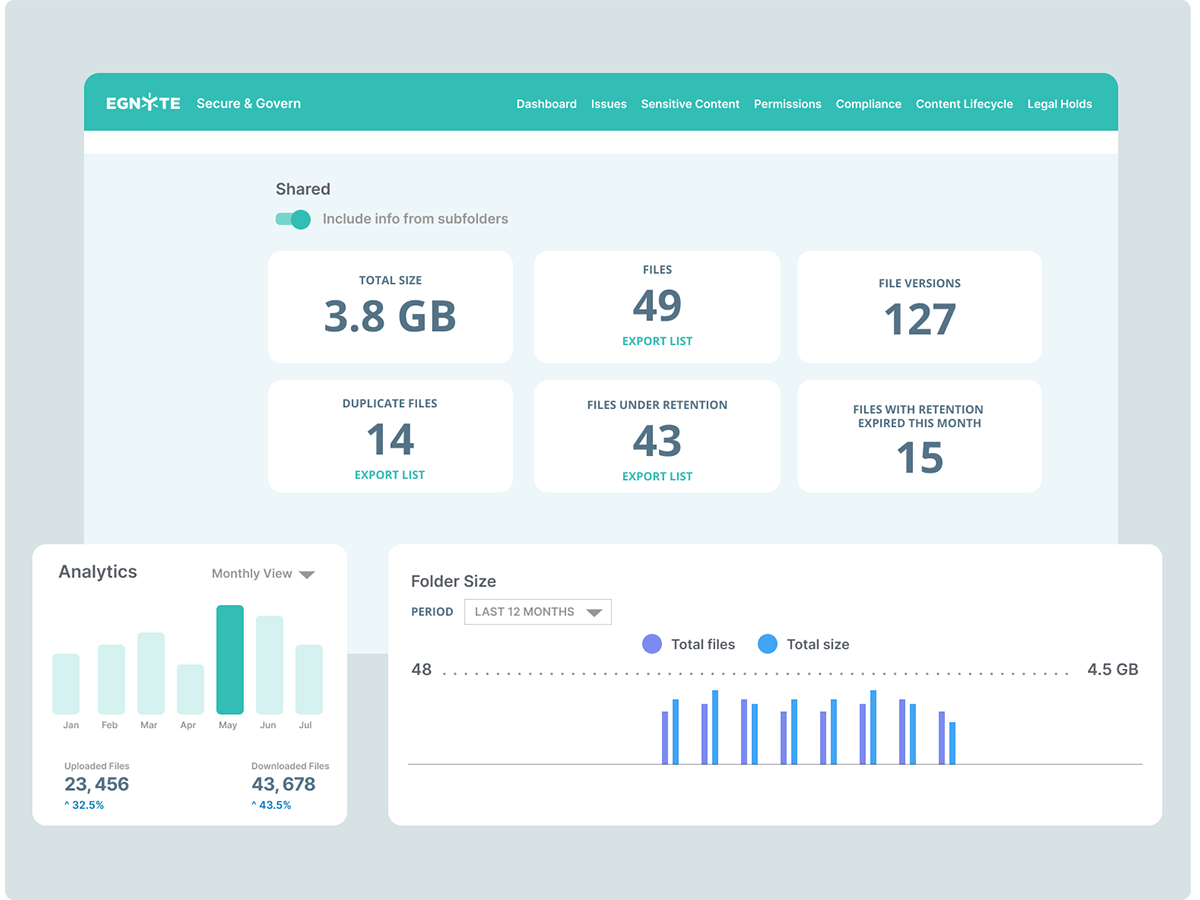
A core component of Egnyte, Governance delivers automated compliance, risk management, and real-time threat detection.

Cloud Apps vs. File Servers
Learn why cloud applications beat on-prem servers for flexibility, scalability, and security.