
Transforming Content Insights with AI-Powered Decision Making
Organizations generate more content than teams can review, interpret, or act on manually. Files, documents, and messages spread across systems, making it difficult to extract insight at the moment decisions need to be made. As a result, decisions usually rely on partial information or outdated context. That's the problem AI decision-making aims to solve.
AI-powered decision-making refers to the use of artificial intelligence to address the said gap by changing how content insights are prepared. It uses AI and machine learning algorithms to back decisions by analyzing huge datasets, identifying patterns, and preparing actionable inputs to optimize content strategies and improve business outcomes.
In content, AI-powered decision-making focuses on extracting meaning from unstructured sources such as documents, reports, and communications. AI systems summarize, classify, and surface information so decision-makers can review it with context. In business, AI assists by reducing the effort required to interpret large volumes of data and content. This approach aligns with intelligence in decision-making, where insight quality matters more than automation.
Let’s jump in and learn:
- Main takeaways
- Why are Businesses Tapping into AI for Making Decisions?
- How do AI-driven Content Insights Transform Businesses?
- Where Can AI-Powered Decision-Making Be Utilized in Content Strategy?
- When is the Right Time to Implement AI into Your Decision-Making Process?
- Experiencing the Transformation: How Egnyte Improves Decision Making and Content Insights
Main takeaways
- AI-powered decision-making improves how content insights enrich decision-making.
- AI in decision-making supports judgment by preparing context, not by choosing outcomes.
- Businesses adopt AI-driven decision-making to manage scale, speed, and content volume.
- Content insights become more useful when governed, contextualized, and seamlessly shared.
- Platforms determine whether AI decision-making strengthens control or introduces risk.
Why are Businesses Tapping into AI for Making Decisions?
Businesses are adopting AI-based decision-making because manual processes are not efficient and scalable anymore. As content volumes increase, teams struggle to locate relevant information in time to support decisions. This leads to challenges like delays, rework, or decisions based on incomplete context.
AI-based decision-making helps address these challenges by preparing content insights consistently. Instead of relying on ad hoc searches, organizations use AI to highlight patterns, exceptions, and relationships across content. This reduces cognitive load and allows leaders to focus on evaluation rather than information gathering.
Another driver is risk. Without governance, decisions made on unmanaged content can expose organizations to compliance and security issues. AI systems that operate within controlled environments help maintain oversight while improving decision support and helping transform businesses with content insights.
How do AI-driven Content Insights Transform Businesses?
AI-driven decision-making transforms businesses by changing how insight flows through the organization. Rather than treating content as static records, AI systems continuously analyze content to keep insights current. This transformation shows up in practical ways where:
- Decision-makers receive summarized, contextual views instead of reviewing full document sets.
- AI surfaces relevant sections, themes, and exceptions, reducing the need for manual scanning.
- Teams spend less time interpreting repetitive or low-value information and more time evaluating implications.
AI-driven content insights also improve consistency because:
- Similar decisions rely on similar inputs, regardless of who prepares them.
- Insight preparation follows defined rules rather than individual interpretation.
- Decisions become easier to review and explain because inputs are structured and traceable.
Note that accountability does not shift to AI. Instead, it prepares and filters information for personnel to interpret and choose actions based on the outputs. Judgment remains human, informed by clearer and more timely insight delivery. The advantage lies in the speed and reliability of insight flow, not in automated decision-making authority.
In this model, AI and decision-making work together by improving input quality while preserving ownership, context, and responsibility. The transformation lies in how quickly and reliably insight reaches decision-makers, and how intelligence in decision-making is applied to utilize an effective content strategy.
Where Can AI-Powered Decision-Making Be Utilized in Content Strategy?
AI-powered decision-making plays a role wherever content informs action. In content strategy, this includes four such areas: governance, compliance, research, and operational planning. Here’s a quick overview:
- In governance:
- AI helps identify policy-relevant content by classifying and tagging files based on rules and context.
- Decision-makers can review summarized governance signals instead of manually inspecting large repositories. - In compliance:
- AI surfaces documents, clauses, or patterns that may require review before actions are taken.
- Document insights help teams assess risk earlier, rather than reacting after issues emerge. - In research:
- AI aggregates insights from reports, notes, and reference materials to support informed evaluation.
- Researchers spend less time locating information and more time assessing relevance and implications. - In operational planning:
- AI highlights trends and exceptions across operational content like plans, updates, and records.
- Leaders gain visibility into recurring issues or dependencies that affect execution decisions.
In regulated environments, AI helps surface risk indicators while respecting data security using AI practices. When combined with content intelligence solutions and applied at the right time, AI supports the decision-making process with consistent interpretation of content across teams. This guarantees that insights derived from content align with organizational rules rather than individual judgment alone.
When is the Right Time to Implement AI into Your Decision-Making Process?
The right time to implement AI in decision-making is when content volume begins to outpace human review capacity. If teams rely heavily on manual searches or informal knowledge sharing, it often leads to inconsistent, lower-quality insights. AI helps streamline decision-making by suggesting what specific input or insight is necessary for making a particular decision.
AI decision-making works best when introduced as support, not replacement. Starting with limited, governed, and well-defined use cases reduces risk and builds trust in outputs. This is where comprehensive solutions like Egnyte play a critical role, aligning intelligent decision-making with governance, oversight, and accountability.
Experiencing the Transformation: How Egnyte Improves Decision Making and Content Insights
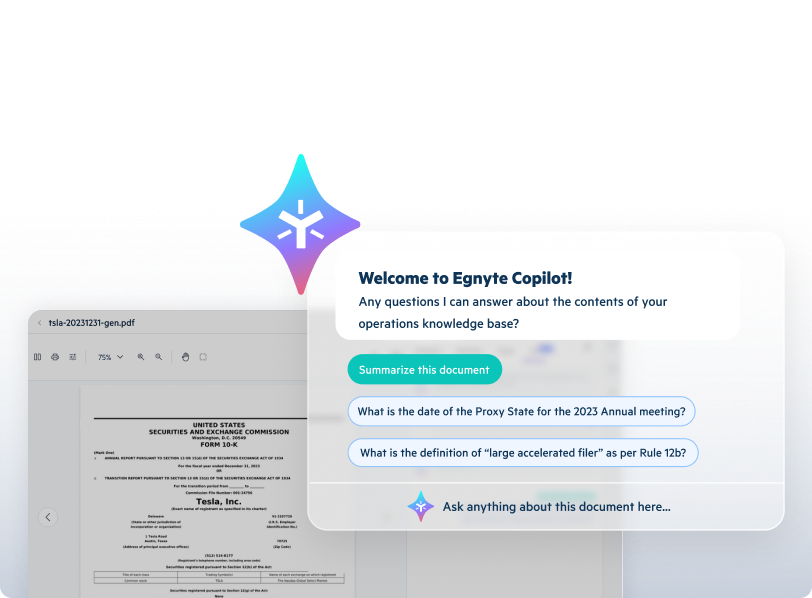
AI-powered decision-making depends on where and how AI operates. Egnyte Intelligence supports AI-powered decision-making by providing a governed environment where AI operates on trusted, permissioned content. Tools like Egnyte’s AI-Assistant allow teams to review summaries, explore patterns, and validate context before acting, keeping decisions accountable and human-led.
Through its data intelligence cloud, Egnyte connects content, metadata, and AI analysis in one system. When AI runs within governed systems, it amplifies decision quality without weakening control, and the platform becomes the bridge between content intelligence and human judgment.
Artificial intelligence and decision-making work best together when roles remain clear: AI supports interpretation at scale, and people remain responsible for decisions and outcomes. Organizations that treat AI as an insight partner rather than a decision-maker improve consistency, reduce risk, and make better use of their content for smarter decision-making.
Frequently Asked Questions
AI powers decision making by analyzing large volumes of content and data to surface patterns, summaries, and exceptions. It prepares relevant context and insights so decision-makers can evaluate information faster and more consistently, while final judgment and accountability remain with humans.
Businesses use AI in decision making to manage scale, speed, and growing content volumes. AI reduces manual effort, improves insight consistency, and ensures decision-makers receive timely, contextual information, helping them act with greater confidence and reduced operational risk.
AI improves secure content insights by summarizing documents, classifying files, highlighting relevant sections, and identifying patterns or risks. This enhances clarity, reduces information overload, and ensures insights are contextualized, governed, and easier to review during decision-making processes.
It is time to implement AI when content volumes exceed human review capacity, decisions rely on incomplete context, or teams spend excessive time searching for information. These signals indicate that AI can help streamline insight preparation and improve decision support.
Examples include AI flagging compliance risks in documents, summarizing research materials for faster evaluation, identifying governance-relevant content, and highlighting operational trends. These applications allow leaders to focus on evaluating implications rather than manually reviewing large content sets.
A leading solution applies AI within governed systems to analyze trusted, permissioned content. It summarizes information, surfaces patterns, and preserves context while enforcing access controls, ensuring insights are reliable, reviewable, and aligned with organizational rules.
AI-powered decision making transforms content insights by shifting them from static records to continuously analyzed inputs. Insights become timely, structured, and traceable, enabling consistent interpretation and faster delivery to decision-makers without removing human oversight or responsibility.
Egnyte has experts ready to answer your questions. For more than a decade, Egnyte has helped more than 22,000+ customers with millions of users worldwide.
Additional Resources

Data Intelligence
AI‑driven insights that strengthen governance and reduce risk.
Egnyte Intelligence
AI‑powered tools that deliver fast, reliable insights and streamline content workflows.

AI Workflow Automation
Automate document tasks with AI-driven triggers that boost efficiency and streamline approvals. [egnyte.com]