Why Better Context Makes AI More Accurate, Faster, and Less Expensive
Ask an AI system a question about your business and, before it can answer, it has another problem to solve: What information actually matters?
It has to find the right files. Determine which version is current. Understand how those files relate to a project, client, deal, or other piece of work. Figure out which information applies to the person asking. Then assemble enough of that information to make a useful decision.
For someone who works in the business every day, much of that is obvious.
A construction manager knows that a submittal is tied to a specific project, specification section, revision, contractor, and review stage. An investment team knows that a contract needs to be read in the context of the deal, counterparty, effective date, and latest amendments.
AI doesn’t automatically know any of that.
Without that business understanding, it has to piece those relationships together every time someone asks it a question. That means more searching, more content to process, and more opportunities to pull in the wrong information.
At Egnyte, we wanted to understand how much of a difference it would make if AI started with business context already in place.
Putting the Egnyte Context Layer to the test
We ran an internal benchmark using a corpus of 1,800 documents.
We kept the model, agent, documents, and questions the same. What changed was the context available to the agent.
In the first test, the agent used a traditional hybrid retrieval approach with an agentic RAG loop. It had access to the content, but had to search for the right information and piece together the relationships it needed as it worked.
In the second, the agent used the Egnyte Context Layer, where relevant business context had already been organized around the content before the model was asked to reason over it.
The difference was significant:
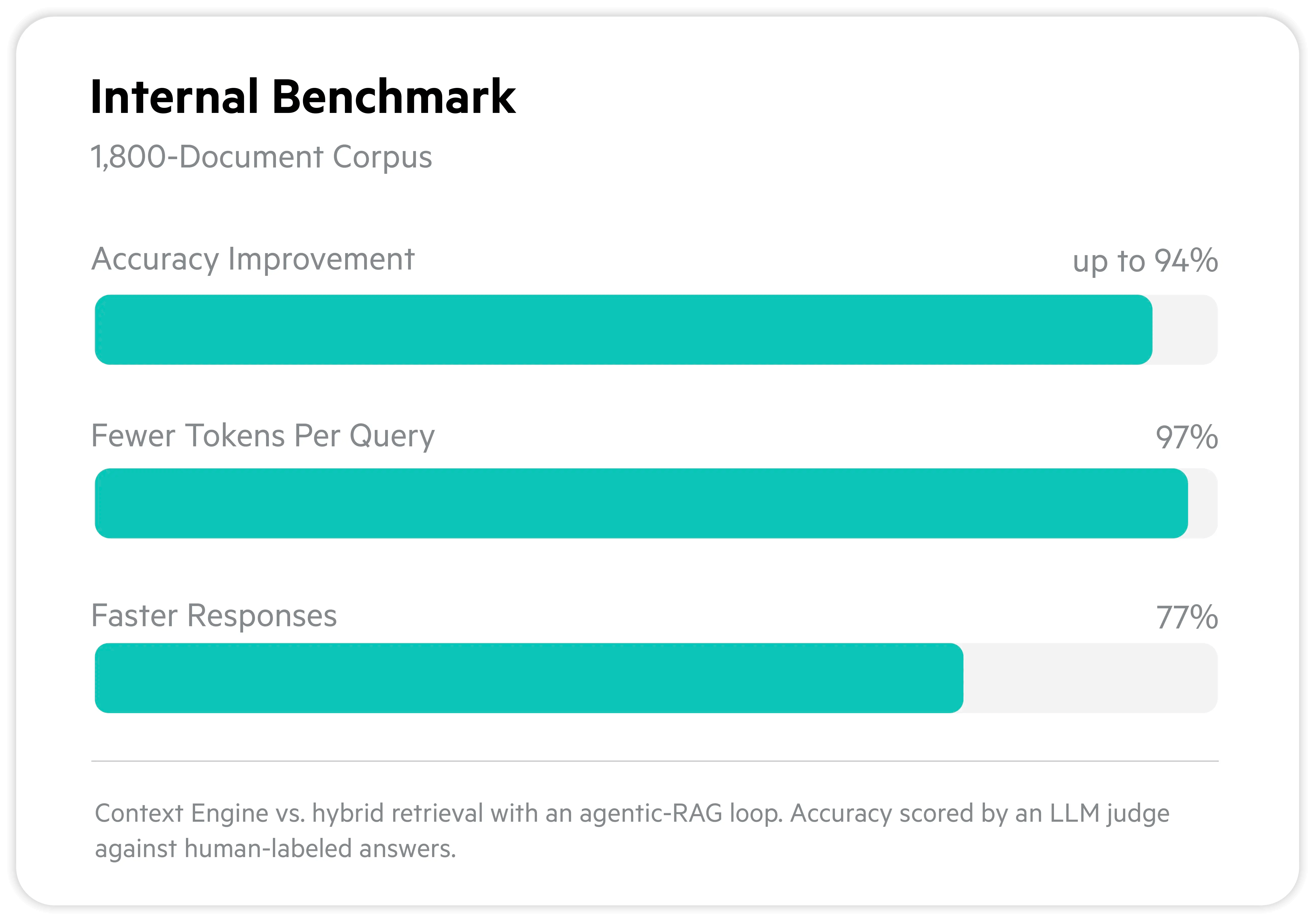
94% improvement in answer accuracy
97% fewer tokens per query
77% faster responses
The model stayed the same. What changed was the context it had to work with.
And that helped us understand something important: a lot of the cost and complexity of enterprise AI comes from the work it has to do to get to the answer.
Better context gives AI a head start
Take a typical business question.
The information needed to answer it may be spread across several files, versions, people, systems, and stages of work. Without enough context, the AI has to search broadly and work out which pieces belong together.
Egnyte does that work ahead of time.
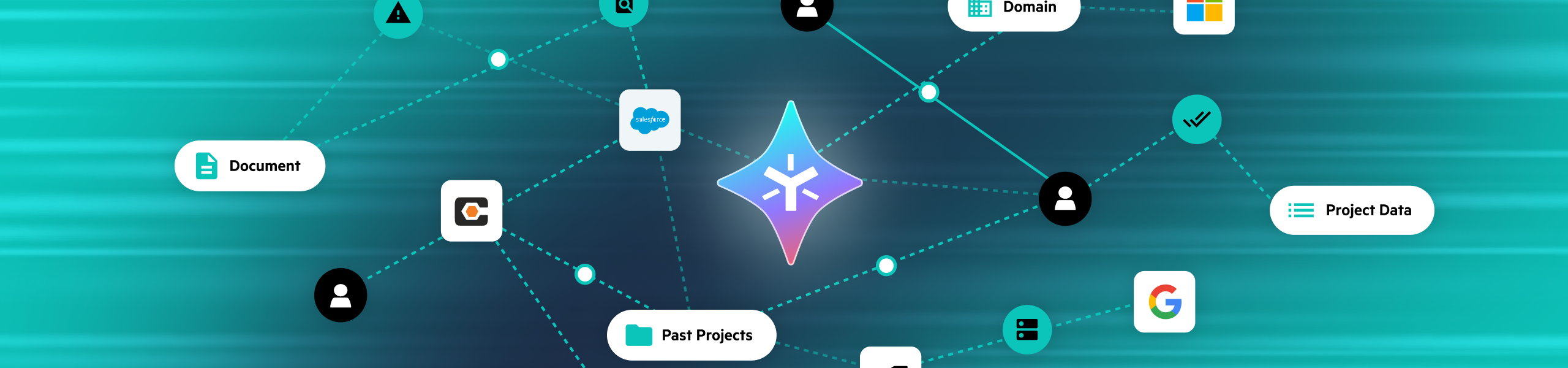
The Context Layer organizes information around the relationships that matter to the business. Content can be enriched with document type, metadata, important entities, and connections to the projects, clients, deals, people, or other work it relates to. Relevant information from connected systems can also become part of that context.
When a question comes in, AI can work from a more focused set of information from the start.
That showed up clearly in our benchmark.
More accurate answers
Accuracy depends heavily on what information reaches the model.
If AI retrieves an outdated file, misses an important relationship, or pulls in information that is related but not relevant to the task, the answer suffers.
The Context Layer gives the model a clearer picture of the business situation around the question. It can understand which content is current, what other information it's connected to, and how it fits into the work being done.
In our benchmark, that led to up to a 94% improvement in answer accuracy.
When AI starts with more relevant information, it has a better foundation for reasoning.
Faster responses
The Context Layer also reduces the amount of discovery the AI has to do before it can respond.
Without pre-built context, an agent may need several search and retrieval steps just to figure out which information matters.
With the relevant relationships already mapped, it can get to the useful information faster.
In our testing, that translated into 77% faster responses.
For the user, that means less waiting and getting on with the work sooner.
Lower processing costs
Of the three results, the most notable finding for our team was the drop in token usage.
Every document retrieved and every piece of text passed through the model adds to the amount of AI processing required to answer a question.
If the model has to search through a large volume of content to establish context, that processing happens every time a new question is asked.
In our benchmark, the Context Layer required 97% fewer tokens per query.
That doesn't mean every customer will see a 97% reduction in AI costs. Results will vary based on the workload, model, data, and retrieval approach.
But the implication is clear.
When AI can focus on the information that matters, it has less to process. And that can make it more cost-effective to scale AI across the business.
Context also has to respect who is asking
Business context is only useful if the right information reaches the right person.
The Egnyte Context Layer works within the permissions and governance already applied to content. Access is resolved before information is assembled for the model, so users don't gain access to content through AI that they could not otherwise see.
That same foundation can support assistants, agents, workflows, APIs, and external AI tools while keeping existing access controls in place.
For enterprise AI, relevance and governance have to work together.
Our results line up with what Gartner is seeing
This was an internal Egnyte benchmark. We designed it, ran it, and evaluated the answers against human-labeled results using an LLM judge. Different datasets, questions, and retrieval configurations will produce different results.
But the direction of what we found lines up closely with broader industry research.
Gartner predicts that by 2027, organizations that prioritize semantics in AI-ready data can increase agentic AI accuracy by up to 80% and reduce costs by up to 60%.
We're seeing the same pattern in our own testing.
Better business context helps AI spend less effort figuring out what matters and more effort doing the work the user asked it to do.
For Egnyte customers, that can mean more accurate answers, faster results, and a more cost-effective way to scale AI across the business.
Want to see the Egnyte Context Layer in action?
Request a demo, or join us at State of Egnyte on October 15 to see how better context is helping AI deliver more accurate, faster, and more cost-effective results.